What Is STP Marketing? Narrowing the Market in Three Steps
STP marketing narrows the whole market down in three steps, in order — Segmentation (splitting the market into groups), Targeting (choosing which group to pursue), and Positioning (deciding where you stand in that group's mind) — to clarify who you serve, what you offer, and how. This three-step path from segmentation through targeting to positioning is widely credited to management scholar Philip Kotler, who systematized and popularized it (the positioning piece also traces a close lineage to Al Ries and Jack Trout's work). Aim at the whole market and your message tends to land with no one; STP narrows things down so your limited resources hit a real target and a clear position. This guide walks through the three steps, how it differs from 3C and SWOT, and how to feed SWOT, with a café example.
What STP marketing is — narrowing the market in three steps
STP moves through three steps in order: split the market up, choose who to pursue, and decide where you stand. Segmentation first divides the market into meaningful groups; targeting then picks which group(s) to pursue; positioning defines what distinct place you occupy in that group's mind.
The point is to move through the three steps in order. Talking about positioning before deciding who you're targeting rings hollow, and picking a target without first segmenting rests on thin evidence. Narrowing down "who you serve" before the whole market is the shortcut to making limited resources count.
Walking the three steps in order (a café example)
Take a small café near a station and walk through the three steps of STP.
- Segmentation: split the market along meaningful lines. E.g., commuters who value morning speed; remote workers who linger and use Wi-Fi; students who prioritize price. You can segment on geography, behavior, values, and more.
- Targeting: choose which segments to pursue. E.g., leaning on the station-front location, pursue both commuters and remote workers. Skip the student segment, where price competition is fierce and the self-roasting strength doesn't pay off.
- Positioning: decide what distinct place you occupy, versus competitors, in the targeted group's mind. E.g., position as "a cup near the station, self-roasted," differentiating from chains' uniform taste.
The decision flow: feeding STP into SWOT and Cross-SWOT
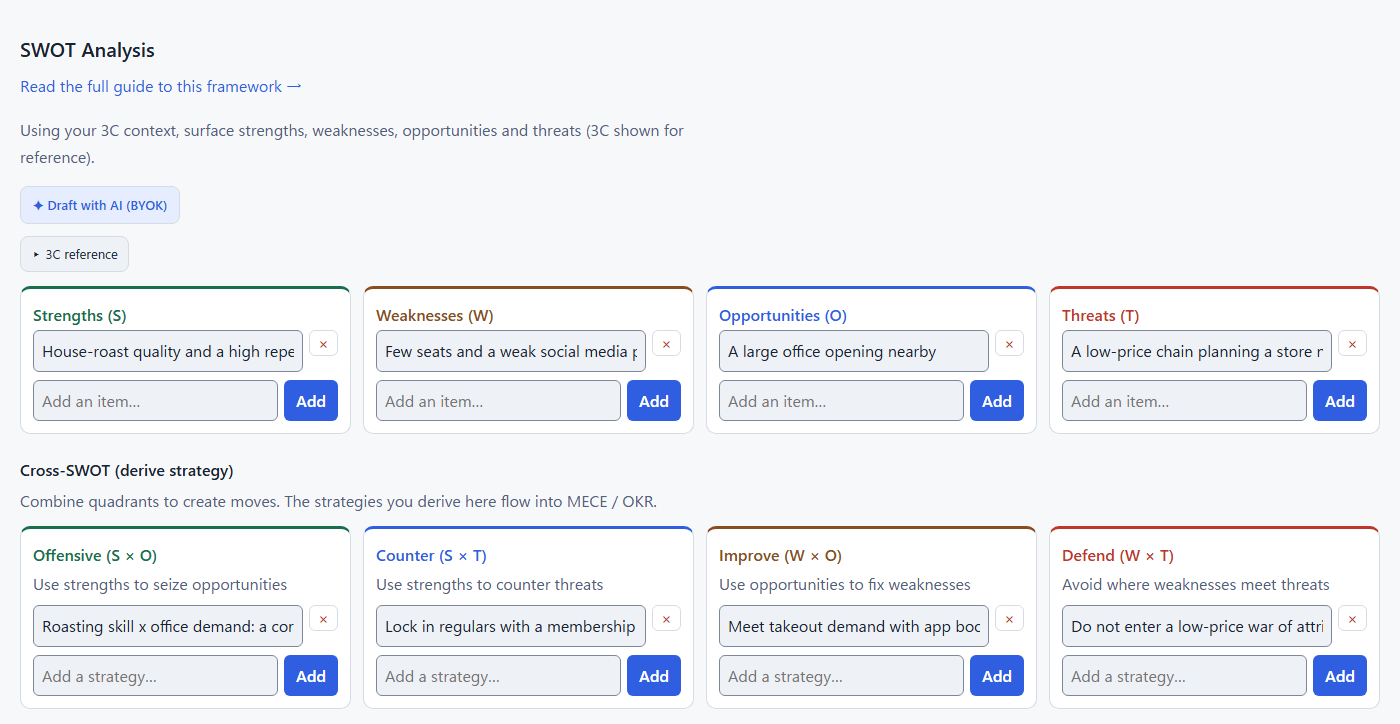
The needs of the segment you targeted, and the competitive landscape there, become material for SWOT's "opportunities" and "threats." The more clearly you define who you're pursuing, the clearer it becomes what to read as an opportunity and what as a threat.
The position you defined gives SWOT's "strengths" something concrete. A position like "near the station, self-roasted" only holds up because a real strength — skill, location — backs it. Feed the "who and what" that STP narrows down straight into SWOT, and the analysis gets concrete.
How it differs from 3C and SWOT — see the whole market, then narrow the customer
3C surveys the whole market through three players: Customer, Competitor, and Company. STP digs further into that "customer," splitting the market, choosing a target, and defining a position. The natural order is: get the big picture with 3C → narrow the customer with STP.
SWOT then organizes the opportunities, threats, strengths, and weaknesses that 3C and STP surfaced onto one page. Decide "who you serve and what" with STP before moving to SWOT, and the opportunities, threats, and strengths become concrete — framed around that specific audience.
Run STP → SWOT → Cross-SWOT → MECE → OKR
Stopping at STP alone tends to leave you having "only listed segments." Connect the target and position to strategy and action. Decide who you serve and what with STP (+ get the big picture with 3C) → organize opportunities, threats, strengths, and weaknesses with SWOT → derive strategy with Cross-SWOT (TOWS) → decompose the issues and prioritize with MECE → land them into measurable OKR targets. That chain turns your target audience into concrete moves.
This STP → SWOT → Cross-SWOT → MECE → OKR runs on one screen in this strategy cockpit. Everything you enter is stored only on your device (nothing is sent to our servers), and you can try the AI draft in SWOT for free with your own API key (BYOK; you cover only the API usage). A one-time $9.90 purchase unlocks the AI across all frameworks. Daily number tracking can be handed off to the sister app, Baton Board.
FAQ
What are the three steps of STP marketing?
Segmentation (splitting the market into meaningful groups), Targeting (choosing which segment(s) to pursue), and Positioning (deciding what distinct place you occupy in the targeted group's mind). Working through them in that order narrows down who you serve, what you offer, and how.
How do I choose between STP and 3C analysis?
3C surveys the whole market through Customer, Competitor, and Company; STP further splits that "customer," picks a target, and defines a position. Get the big picture with 3C first, then narrow your target with STP — that two-step order works well.
What is the weakness of STP marketing?
Results swing heavily on how you draw the segmentation lines, and there is no single right answer. Choosing a target and a position also isn't a move on its own. That is why you convert it to strategy with SWOT and Cross-SWOT and land it into measurable OKR targets.
Can you give a concrete example of the three STP steps (a café example)?
Segmentation — commuters who value morning speed; remote workers who linger and use Wi-Fi; students who prioritize price. Targeting — leaning on the station-front location, pursue commuters and remote workers. Positioning — "a cup near the station, self-roasted," differentiating from chains' uniform taste.
Who is credited with STP marketing?
The three-step path from segmentation through targeting to positioning is widely credited to management scholar Philip Kotler, who systematized and popularized it (the positioning piece also traces a close lineage to Al Ries and Jack Trout's work).
Other guides
- How to Do a SWOT Analysis — Complete Guide with Cross-SWOT (TOWS)
- How to Write OKRs — A Practical Guide with Examples
- How to Do a 3C Analysis — Customer, Competitor, Company
- What Is MECE? — Decompose Any Problem Without Gaps or Overlaps
- How to Use the TOWS Matrix (Cross-SWOT) — Turn Four Quadrants into Strategy
- Strategy Frameworks Explained — Use 3C, SWOT, TOWS, MECE and OKRs Together
- KPI vs OKR — the difference, when to use each, and how to connect them
- Turn Strategy into Execution — Running PDCA and Tracking the Daily Numbers (with Baton Board)
- Strategy Frameworks by Industry — 3C→SWOT→OKR Worked Examples for Four Business Types
- The Limits of SWOT Analysis — and How to Complement Them
- What Is PEST Analysis? Read the Macro-Environment and Feed SWOT
- What Is Porter's Five Forces? Read an Industry's Profit Structure
- What Is Value Chain Analysis? Break Down Internal Activities and Feed SWOT
- What Is the Ansoff Matrix? Choose a Growth Path by Product × Market and Feed OKR
- What Is a Logic Tree? — Break a Problem Down Branch by Branch (What/Why/How)
- What Is VRIO Analysis? Evaluate Internal Resources with Four Questions and Pick SWOT's Strengths
- How to Choose a Strategy Framework — Which One, and When
- What Is the BCG Matrix (PPM)? Allocate Resources Across Businesses in Four Quadrants
- What Is Jobs to Be Done (JTBD)? Finding the "Job" Your Customer Needs Done
- Balanced Scorecard (BSC): four perspectives and a strategy map
- Business Model Canvas (BMC): nine building blocks on one page
Try it right in your browser (free, no signup)
Narrow the market in three steps with STP, then move to SWOT → Cross-SWOT → MECE → OKR. One screen; strategy data stays on your device; the SWOT AI draft is free (BYOK).
Open the app →