KPI vs OKR — use both, but don't mix them
KPIs and OKRs are often talked about as if they were the same thing, but their jobs are clearly different. In short, a KPI is a gauge that continuously watches whether your business runs in a healthy range, while an OKR is an ambitious goal you want to reach in a set period, together with the results that measure it. Confuse the two and an ambitious goal quietly becomes a maintenance target, or a metric that should just be monitored suddenly turns into a goal that exhausts the team. This guide explains the difference, when to use each, and how to connect both without friction, with a small worked example.
In one line — KPIs monitor, OKRs challenge
A KPI (Key Performance Indicator) measures the ongoing health of a business or team. Things like churn rate, gross margin or utilization tell you, day by day or week by week, whether you are inside a normal range.
An OKR (Objectives and Key Results) is an ambitious goal (the Objective) you want to reach in a period such as a quarter, paired with quantitative results (Key Results) that measure how far you got. It points at what you want to change or grow.
Put differently, KPIs are your defensive dashboard and OKRs are your offensive plan. You need both, and you must not blend them.
What each one is, and where it comes from
KPIs come from general management and operations practice; they are not attributed to a single inventor. What matters is narrowing to a small set of indicators you watch continuously — track too many and you end up watching none.
OKRs originate in the goal-setting Andy Grove used at Intel and were popularized by John Doerr at companies such as Google. The basic shape: the Objective is qualitative and ambitious, the Key Results are quantitative and verifiable.
- KPI examples: monthly churn under 3% / gross margin above 40% / first support reply within 2 hours
- OKR example: Objective 'Become the default choice for business customers' / KRs 'Sign 10 corporate accounts', 'Reach 90% retention', 'Lift NPS by 20'
When to use which — is it something to keep, or to change?
The test is simple. If you want to keep or monitor it, it is a KPI. If you want to change or take it on within a period, it is an OKR.
For a small cafe, the daily cost ratio, average check and repeat rate are KPIs you watch all the time. Winning the corporate demand in the nearby office district, on the other hand, is this quarter's OKR.
Be careful not to crown a healthy KPI as an OKR. Keeping the cost ratio steady is a KPI’s job, not an ambitious OKR. And in the other direction, an ambitious goal without measurable Key Results is just a vague aspiration — the measurable KR is what makes it an OKR.
Connecting the two — KPIs and OKRs flow into each other
KPIs and OKRs are different, but not disconnected. In fact they should flow into each other.
- When a KPI breaks its threshold, make fixing it your next OKR (e.g. churn worsens, so "Stop the churn" becomes an Objective).
- When an OKR result sticks, move it into your standing KPIs to monitor (e.g. you hit 90% corporate retention, then keep it as a KPI afterwards).
Related explainer (external site): Connect daily reports to KPIs and targets
This loop keeps OKRs from being one-off fireworks and keeps KPIs from becoming numbers you watch out of habit. You push, move the win to defense, then push again.
From design to operation — decompose into OKRs, track daily with KPIs
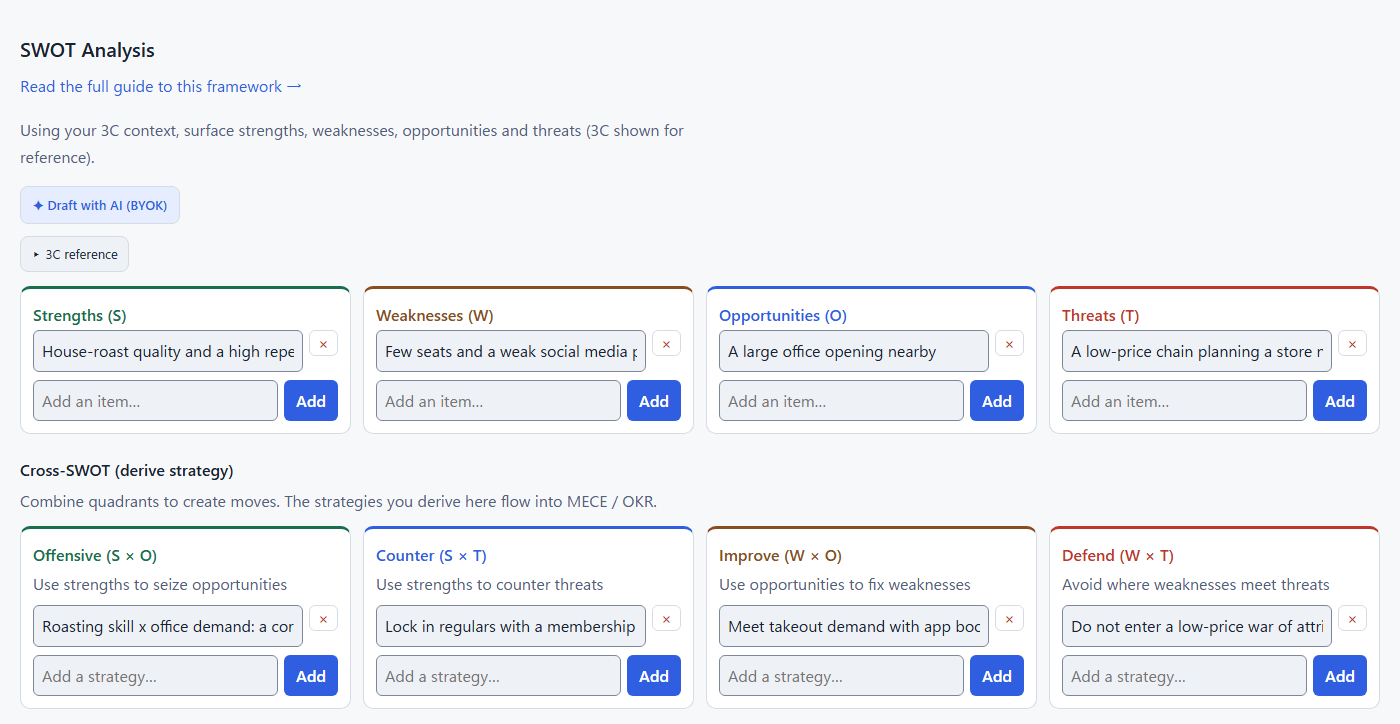
Good OKRs do not appear out of thin air. Read the environment with 3C (Customer, Competitor, Company), organize it with SWOT, derive strategy with Cross-SWOT (TOWS), and break the issues down with MECE (no gaps, no overlaps) — only then can you land an Objective and measurable Key Results.
This whole flow — 3C → SWOT → Cross-SWOT → MECE → OKR — is what our strategy cockpit chains on a single screen. Everything you type is stored on your device only (nothing is sent to our servers). You can try AI drafting for free on SWOT using your own API key (BYOK); a one-time $9.90 purchase unlocks AI across every framework.
Tracking those designed KPIs/OKRs as daily numbers over time is where the sister app Baton Board shines. Design here, track day to day in Baton Board — splitting the roles this way makes it sustainable.
FAQ
Should I decide KPIs or OKRs first?
Usually it is natural to first understand your current KPIs (health metrics), find what you want to change or grow among them, and turn that into an OKR. But for a new venture with few existing metrics, the order flips: set direction with an OKR first, then define KPIs as the way to measure achievement.
Can a KPI and an OKR use the same metric?
Temporarily, yes. Making 90% retention this quarter's KR and then moving it into a standing KPI after you hit it is a healthy transition. Just don't make everything a goal all the time, or the team burns out — keep what only needs watching as a KPI.
Do individuals or small teams need OKRs?
Not mandatory, but useful. The fewer your resources, the more it pays to narrow what you will take on this period to one or two things. Watching daily health with KPIs while betting on a single OKR is a light setup that works well.
How do a KPI and an OKR connect when a KPI worsens?
When a KPI crosses a threshold, turning it around becomes the next OKR (e.g., churn rate worsens → the Objective becomes "stop the churn"). Conversely, once an outcome an OKR created has stuck, it moves over to become a KPI you monitor going forward. That back-and-forth keeps OKRs from being a one-off fireworks show and keeps KPIs from becoming numbers nobody questions.
Where do KPIs and OKRs come from?
KPIs are a general practice widely used in management accounting and operations, not credited to a single inventor. OKRs trace back to the goal-setting practice Andy Grove used at Intel, popularized more broadly — including at Google — by John Doerr.
Other guides
- How to Do a SWOT Analysis — Complete Guide with Cross-SWOT (TOWS)
- How to Write OKRs — A Practical Guide with Examples
- How to Do a 3C Analysis — Customer, Competitor, Company
- What Is MECE? — Decompose Any Problem Without Gaps or Overlaps
- How to Use the TOWS Matrix (Cross-SWOT) — Turn Four Quadrants into Strategy
- Strategy Frameworks Explained — Use 3C, SWOT, TOWS, MECE and OKRs Together
- Turn Strategy into Execution — Running PDCA and Tracking the Daily Numbers (with Baton Board)
- Strategy Frameworks by Industry — 3C→SWOT→OKR Worked Examples for Four Business Types
- The Limits of SWOT Analysis — and How to Complement Them
- What Is PEST Analysis? Read the Macro-Environment and Feed SWOT
- What Is Porter's Five Forces? Read an Industry's Profit Structure
- What Is Value Chain Analysis? Break Down Internal Activities and Feed SWOT
- What Is the Ansoff Matrix? Choose a Growth Path by Product × Market and Feed OKR
- What Is a Logic Tree? — Break a Problem Down Branch by Branch (What/Why/How)
- What Is VRIO Analysis? Evaluate Internal Resources with Four Questions and Pick SWOT's Strengths
- What Is STP Marketing? Narrow the Market in Three Steps to Decide Who to Serve
- How to Choose a Strategy Framework — Which One, and When
- What Is the BCG Matrix (PPM)? Allocate Resources Across Businesses in Four Quadrants
- What Is Jobs to Be Done (JTBD)? Finding the "Job" Your Customer Needs Done
- Balanced Scorecard (BSC): four perspectives and a strategy map
- Business Model Canvas (BMC): nine building blocks on one page
Try it right in your browser (free, no sign-up)
3C → SWOT → Cross-SWOT → MECE → OKR on one screen. Go all the way from decomposing issues to landing them as OKRs. Strategy data stays on your device; AI drafting on SWOT is free (your own API key — BYOK).
Open the app →