How to Write OKRs — Objectives That Inspire, Key Results That Measure
OKRs are simple on paper and easy to get wrong in practice. The two most common failures are writing Key Results that are really a to-do list, and setting an Objective that is just a number with no direction. This guide shows how to write an Objective and Key Results that work together, where they should come from, how to grade them, and the mistakes to avoid — with one concrete example throughout.
What an OKR is — Objective vs. Key Results
An OKR has two parts. The Objective is a short, qualitative, ambitious statement of what you want to achieve — it should be memorable and give direction (“Become the go-to English course for busy professionals”). The Key Results are the measurable outcomes that prove you got there (“raise 30-day retention from 20% to 40%”).
The load-bearing rule: an Objective is qualitative and inspiring; a Key Result is quantitative and verifiable. If your Objective already contains the number, it is probably a Key Result in disguise; if your Key Result has no number, it is probably a task.
Where OKRs come from — strategy, not a wish list
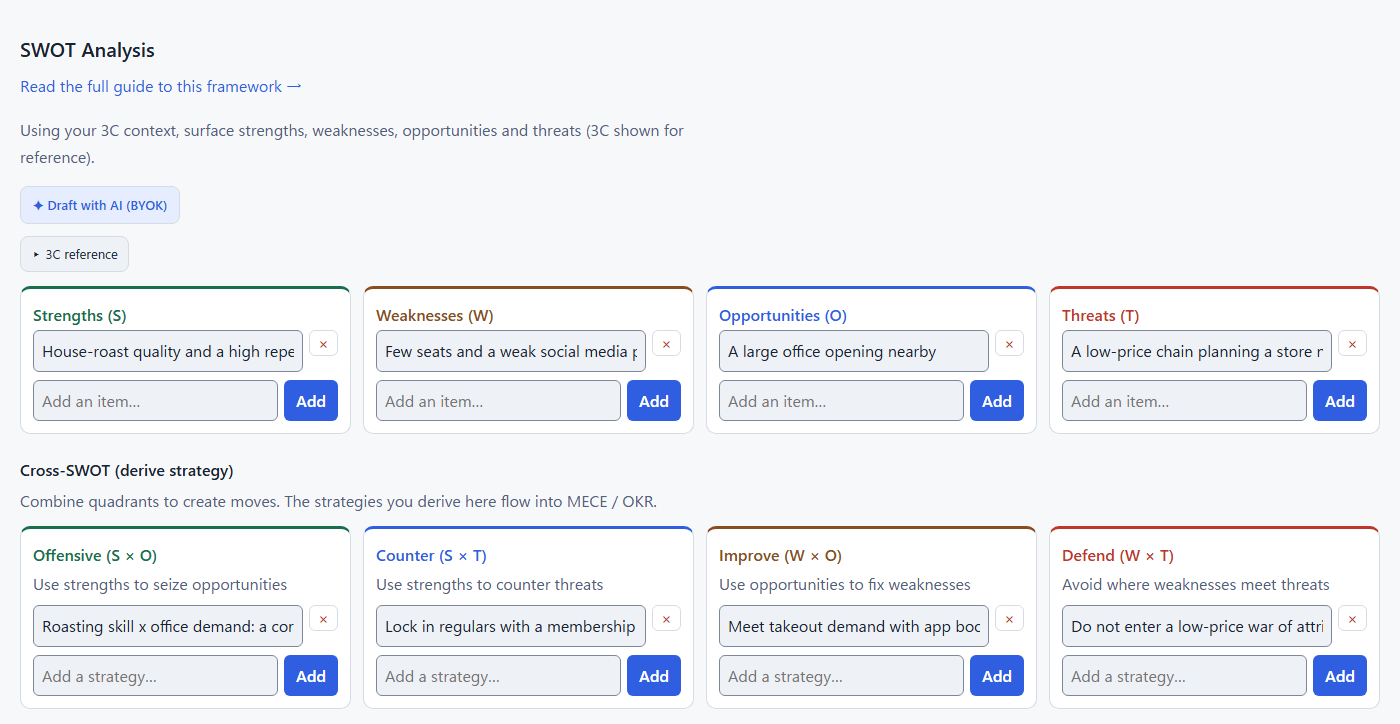
Good OKRs are not brainstormed from scratch each quarter. They are the measurable end of a strategy you already chose. That is why the frameworks connect: a 3C analysis feeds a SWOT, Cross-SWOT (TOWS) derives the strategy, MECE breaks it into workstreams, and each workstream becomes an Objective with Key Results.
Coming from a decomposed strategy is what keeps your OKRs both complete (no important area missing) and focused (you are not inventing goals unrelated to your direction).
Step 1: Write the Objective
Keep it qualitative, ambitious, and time-bound — usually one quarter. Take an online language school as the running example:
- Good: “Become the obvious choice for busy professionals learning English”
- Too timid: “Improve the product a bit”
- Actually a Key Result: “Reach 5,000 paying users” (that is a number — move it to the Key Results)
Aim for one to three Objectives at a time. More than three, and nothing is really the priority.
Step 2: Write Key Results — outcomes, not tasks
Each Objective needs three to five Key Results. A Key Result describes a change in the world, not an activity you performed. The test: could you finish the task and still miss the goal? Then it is a task, not a Key Result.
- Outcome (good): “raise 30-day retention from 20% to 40%”
- Outcome (good): “grow paid conversion from 3% to 6%”
- Outcome (good): “cut average response time from 8h to 2h”
- Task (avoid): “ship the mobile app” — shipping it does not guarantee the goal; measure what shipping should change
Give every Key Result a starting value and a target (“from 20% to 40%”). Without the baseline you cannot tell how far you have moved.
Step 3: Grade, set a cadence, and hand off tracking
Score each Key Result from 0.0 to 1.0 at the end of the period. For ambitious (“stretch”) OKRs, one widely used convention treats around 0.7 as healthy — consistently scoring 1.0 can mean the targets were set too safe. For OKRs you have committed to fully deliver, aim for 1.0. Decide which kind each one is up front, so the score means something.
Set OKRs for a quarter and check in regularly (a quick weekly review of confidence). Setting and grading is a design activity; the day-to-day number tracking that feeds those scores is a different job. Our sister app Baton Board is built for that ongoing KPI tracking — this cockpit focuses on designing the OKR and hands the daily tracking off to it.
Related explainer (external site): How to set goals that get achieved
Our strategy cockpit runs the whole cascade — 3C → SWOT → Cross-SWOT → MECE → OKR — on one screen, with each step feeding the next. The OKR view nudges you to keep the Objective qualitative and every Key Result measurable. Everything you type is stored on your device only (nothing is sent to our servers), and the AI drafting assistant is free to try on SWOT — bring your own API key (BYOK); you pay only your provider's usage. Unlocking AI across every framework is a one-time $9.90.
FAQ
How many OKRs and Key Results should I have?
One to three Objectives at a time, with three to five Key Results each. Fewer, sharper OKRs beat a long list — the point of OKRs is to make priorities obvious, and too many defeats that.
What is the difference between a KPI and an OKR?
A KPI is an ongoing health metric you monitor continuously (e.g. monthly churn). An OKR is a time-boxed goal to change something over a quarter. A KPI can become a Key Result when you set a target to move it; otherwise you just watch it.
What score counts as good?
It depends on the type. For ambitious stretch OKRs, around 0.7 out of 1.0 is often considered healthy, and always hitting 1.0 may mean you aimed too low. For committed OKRs you intend to fully deliver, the target is 1.0. Agree the type before you start so the grade is meaningful.
What is the difference between a strong Objective and a weak one?
A strong Objective is qualitative, sets a direction, and moves people (e.g., "Become the default choice for busy professionals learning English"). A weak Objective is either too vague ("make the product a bit better") or already has a number baked in, blurring the line with a Key Result. If your Objective already contains a number, it may actually be a Key Result in disguise.
How do I tell a Key Result apart from a task?
Ask whether completing the work could still leave the goal unmet. If yes, it's a task, not a Key Result. "Ship the mobile app" is a task — shipping it doesn't guarantee the goal is hit. Measure the number that shipping it is supposed to move instead, like conversion rate.
Other guides
- How to Do a SWOT Analysis — Complete Guide with Cross-SWOT (TOWS)
- How to Do a 3C Analysis — Customer, Competitor, Company
- What Is MECE? — Decompose Any Problem Without Gaps or Overlaps
- How to Use the TOWS Matrix (Cross-SWOT) — Turn Four Quadrants into Strategy
- Strategy Frameworks Explained — Use 3C, SWOT, TOWS, MECE and OKRs Together
- KPI vs OKR — the difference, when to use each, and how to connect them
- Turn Strategy into Execution — Running PDCA and Tracking the Daily Numbers (with Baton Board)
- Strategy Frameworks by Industry — 3C→SWOT→OKR Worked Examples for Four Business Types
- The Limits of SWOT Analysis — and How to Complement Them
- What Is PEST Analysis? Read the Macro-Environment and Feed SWOT
- What Is Porter's Five Forces? Read an Industry's Profit Structure
- What Is Value Chain Analysis? Break Down Internal Activities and Feed SWOT
- What Is the Ansoff Matrix? Choose a Growth Path by Product × Market and Feed OKR
- What Is a Logic Tree? — Break a Problem Down Branch by Branch (What/Why/How)
- What Is VRIO Analysis? Evaluate Internal Resources with Four Questions and Pick SWOT's Strengths
- What Is STP Marketing? Narrow the Market in Three Steps to Decide Who to Serve
- How to Choose a Strategy Framework — Which One, and When
- What Is the BCG Matrix (PPM)? Allocate Resources Across Businesses in Four Quadrants
- What Is Jobs to Be Done (JTBD)? Finding the "Job" Your Customer Needs Done
- Balanced Scorecard (BSC): four perspectives and a strategy map
- Business Model Canvas (BMC): nine building blocks on one page
Build your OKRs in the browser — free, no sign-up
3C → SWOT → Cross-SWOT → MECE → OKR on one screen. The OKR view keeps Objectives qualitative and Key Results measurable. Strategy data stays on your device; the AI draft assistant is free on SWOT (with your own API key — BYOK).
Open the app →