Strategy Frameworks Explained — Connect Them Instead of Using Them Alone
You have probably heard of 3C, SWOT, MECE and OKRs. Each is a well-known strategy framework, but used alone they tend to end as "analyzed and forgotten" or "goals set and forgotten." Their real power shows up when you connect them into a single flow: understand the environment (3C), organize the present (SWOT), derive strategy (Cross-SWOT / TOWS), break issues down (MECE), and land on measurable targets (OKRs). This page is an overview of the five frameworks and the cascade in which each one’s output becomes the next one’s input. Each framework links out to its own detailed how-to guide.
Why connect them instead of using each alone
The classic way a framework fails is skipping the step before it. Write a SWOT without gathering inputs first and you get a brainstormed list; leave a SWOT without converting it to strategy and it ends as a tidy chart. Pass each step’s output into the next, however, and gaps and leaps shrink until you arrive at a plan you can assign to people and measure with numbers.
This flow is the standard analysis cascade used in consulting: 3C → SWOT → Cross-SWOT → MECE → OKRs. It is easiest to hold in mind as three blocks — the front (3C, SWOT) to know the present accurately, the middle (Cross-SWOT) to derive the moves, and the back (MECE, OKRs) to make it executable.
① 3C analysis — know the environment, gather inputs
The starting point is a 3C analysis. You take stock of the environment around the business from three angles: Customer, Competitor and Company. Popularized by strategist Kenichi Ohmae, it asks who is struggling with what and pays for what (customer), who you are compared against and what they are strong at (competitor), and what you have and lack (company).
The notes you gather here become the raw material for the next step, SWOT. Changes in customers and the market flow into opportunities and threats; the gap between you and rivals flows into strengths and weaknesses. See the 3C analysis guide for the full procedure (reachable from "Other guides" below).
② SWOT analysis — organize the present into four quadrants
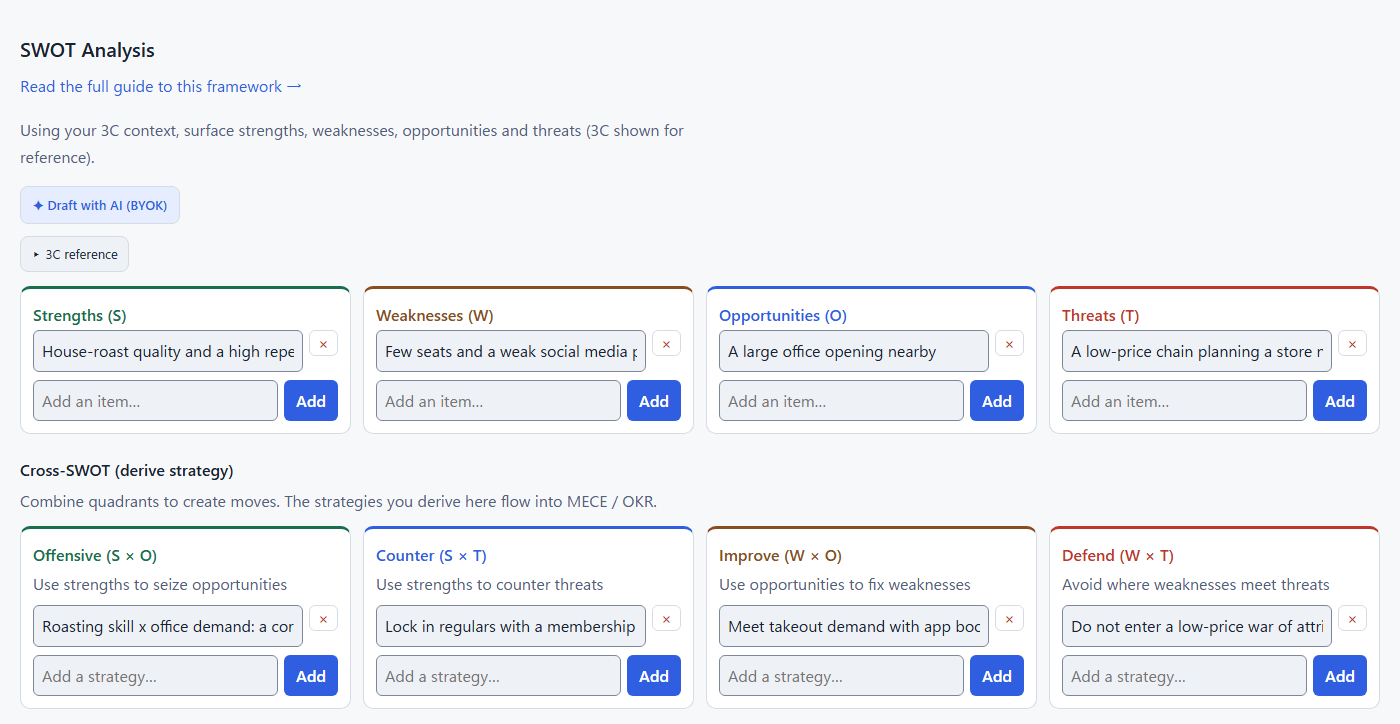
Organize the material from 3C into the four SWOT quadrants: the internal Strengths (S) and Weaknesses (W), and the external Opportunities (O) and Threats (T). The key is the internal/external split: what you can change is internal, while markets, competitors and regulation you cannot change are external. A common mistake is writing what you want to do (launch a new product) in the "opportunity" box — an opportunity is a change in the external environment.
SWOT only organizes; by itself it produces no moves. Do not stop here — always continue to Cross-SWOT next. The dedicated SWOT guide covers how to fill each quadrant well.
③ Cross-SWOT (TOWS) — derive strategy
The heart of the cascade is Cross-SWOT (the TOWS matrix). You combine the four SWOT quadrants to derive four directions of strategy: S×O (use strengths to maximize opportunities = offense), S×T (use strengths to counter threats = differentiate), W×O (use an opportunity to cover a weakness = improve), and W×T (avoid where weakness and threat overlap = defend). Heinz Weihrich systematized this method in 1982.
This is where SWOT’s "organizing" finally turns into "action." You need not pursue all four directions; deciding what NOT to do in W×T is often what concentrates your resources. The dedicated Cross-SWOT guide goes deeper.
④ MECE — break the strategy down with no gaps or overlaps
A derived strategy is still at the grain of a "direction." To execute it, break the issues down with MECE (Mutually Exclusive, Collectively Exhaustive). Popularized at McKinsey and the foundation of Barbara Minto’s Pyramid Principle, it splits a problem so the parts do not overlap (mutually exclusive) and together cover everything that matters (collectively exhaustive).
For "a corporate coffee subscription," for example, you split it into "prospecting," "product and pricing design," and "delivery operations." Only once it is MECE can you assign each issue to a person and measure it with the next step, OKRs. See the MECE guide for the two checks and the common pitfalls.
⑤ OKRs — land on measurable targets
Finally, turn the broken-down issues into measurable targets. OKRs (Objectives and Key Results) is a goal framework created by Intel’s Andy Grove and spread through John Doerr to companies like Google. You set one Objective (a qualitative, ambitious state you want to reach) and hang a few Key Results (quantitative outcomes) that measure it.
If "get the corporate subscription off the ground" is the Objective, then "pitch 10 companies in month one" and "two products with a cost ratio under 40%" are Key Results. Note that tracking the daily numbers is a separate step from design: to follow the metrics you designed over time, it is natural to hand them off to a KPI-dashboard tool. See the OKR guide for how to write them.
Run all five connected, on one screen
Our strategy cockpit is built to run exactly this 3C → SWOT → Cross-SWOT → MECE → OKR flow connected on a single screen. Each step’s output is referenced as the next step’s input, and everything you type is stored only on your own device (nothing is sent to our servers). The fastest way to feel how the five connect is to load the pre-filled sample.
In SWOT you can try AI drafting for free (BYOK — bring your own API key; you only pay your provider’s usage). Using AI across every framework is a one-time $9.90 purchase. No sign-up is required, and you can start right in your browser.
FAQ
In what order should I use the frameworks?
The basic order is 3C → SWOT → Cross-SWOT (TOWS) → MECE → OKRs. Know and organize the environment up front, derive strategy in the middle, and land it in an executable form at the end. Because each step’s output becomes the next one’s input, keeping the order reduces gaps and leaps.
Do I have to use all five?
No. A subset can be effective depending on your goal. But stopping at "SWOT only" produces no moves, so we recommend going at least through Cross-SWOT as a set. Add MECE → OKRs when you want to land on targets, or return to 3C if your grasp of the environment feels thin — use as many steps as you need.
Where should a beginner start?
SWOT is the easiest entry point. Fill the four quadrants, then experience turning them into strategy with Cross-SWOT, and you will feel that these are decision-making tools, not just "analysis." Loading our sample lets you see all five connected at once.
What are the three "blocks" — first half, middle, and second half?
The first half (3C, SWOT) is about accurately reading the current situation. The middle (Cross-SWOT) is about deriving concrete moves. The second half (MECE, OKR) is about landing it into an executable form. Thinking in these three blocks makes it clear the five frameworks are one connected flow, not five separate exercises.
Who is each framework credited to?
3C is credited to Kenichi Ohmae. Cross-SWOT (TOWS) was systematized by Heinz Weihrich in 1982. MECE spread through McKinsey and underlies Barbara Minto's Pyramid Principle. OKR traces back to Andy Grove at Intel and was popularized by John Doerr, including at Google. SWOT is a general framework not credited to a single inventor.
Other guides
- How to Do a SWOT Analysis — Complete Guide with Cross-SWOT (TOWS)
- How to Write OKRs — A Practical Guide with Examples
- How to Do a 3C Analysis — Customer, Competitor, Company
- What Is MECE? — Decompose Any Problem Without Gaps or Overlaps
- How to Use the TOWS Matrix (Cross-SWOT) — Turn Four Quadrants into Strategy
- KPI vs OKR — the difference, when to use each, and how to connect them
- Turn Strategy into Execution — Running PDCA and Tracking the Daily Numbers (with Baton Board)
- Strategy Frameworks by Industry — 3C→SWOT→OKR Worked Examples for Four Business Types
- The Limits of SWOT Analysis — and How to Complement Them
- What Is PEST Analysis? Read the Macro-Environment and Feed SWOT
- What Is Porter's Five Forces? Read an Industry's Profit Structure
- What Is Value Chain Analysis? Break Down Internal Activities and Feed SWOT
- What Is the Ansoff Matrix? Choose a Growth Path by Product × Market and Feed OKR
- What Is a Logic Tree? — Break a Problem Down Branch by Branch (What/Why/How)
- What Is VRIO Analysis? Evaluate Internal Resources with Four Questions and Pick SWOT's Strengths
- What Is STP Marketing? Narrow the Market in Three Steps to Decide Who to Serve
- How to Choose a Strategy Framework — Which One, and When
- What Is the BCG Matrix (PPM)? Allocate Resources Across Businesses in Four Quadrants
- What Is Jobs to Be Done (JTBD)? Finding the "Job" Your Customer Needs Done
- Balanced Scorecard (BSC): four perspectives and a strategy map
- Business Model Canvas (BMC): nine building blocks on one page
Try it right in your browser — free, no sign-up
3C → SWOT → Cross-SWOT → MECE → OKR on one screen. Load the pre-filled sample to feel how the five connect. Strategy data stays on your device; AI in SWOT is free (bring your own API key — BYOK).
Open the app →