What Is Porter's Five Forces? Connecting Industry Structure to SWOT
Porter's Five Forces reads how profitable an industry is — its profit structure — through five forces: (1) the threat of new entrants, (2) the bargaining power of suppliers, (3) the bargaining power of buyers, (4) the threat of substitutes, and (5) rivalry among existing competitors. Michael Porter set it out in his 1979 article "How Competitive Forces Shape Strategy" and systematized it in his 1980 book "Competitive Strategy." Reading an industry's structure first lets you write evidence-based items into SWOT's opportunities and threats. This guide explains each force, how it differs from 3C and PEST, and how to connect it to SWOT, using a café example.
What Five Forces is — reading an industry's profit structure through five forces
Five Forces diagnoses whether an industry is "structurally profitable, or prone to having its profit competed away," through five forces. The stronger the forces, the more profit leaks out of the industry and the harder it is to earn.
The point is to know the "tilt of the playing field" before you spend effort. The same effort earns very different profit in an industry where the five forces are weak (competition is mild) versus one where they are strong (a war of attrition). Read the structure first, then decide where to compete and how to differentiate.
The five forces: what each one covers (a café example)
Take a small café near a station and see how strong each force is.
- 1. Threat of new entrants: the lower the barrier to open, the bigger the threat. A café is easy to start with equipment and a lease, so new shops appear nearby — a fairly high threat.
- 2. Bargaining power of suppliers: your bean roaster and milk supplier. Depending on a specific rare bean gives the supplier power and lets them control your input cost.
- 3. Bargaining power of buyers: the more choices and the lower the switching cost, the stronger the buyer. Cafés have many nearby alternatives and price-sensitive customers — buyers are fairly strong.
- 4. Threat of substitutes: convenience-store coffee, home brewing, energy drinks, tea — "ways to satisfy the need other than a café." Cheap, convenient substitutes are plentiful — a high threat.
- 5. Rivalry among existing competitors: the more nearby cafés and chains, the more it turns into a war over price and location — high rivalry.
Feeding Five Forces into SWOT's opportunities and threats
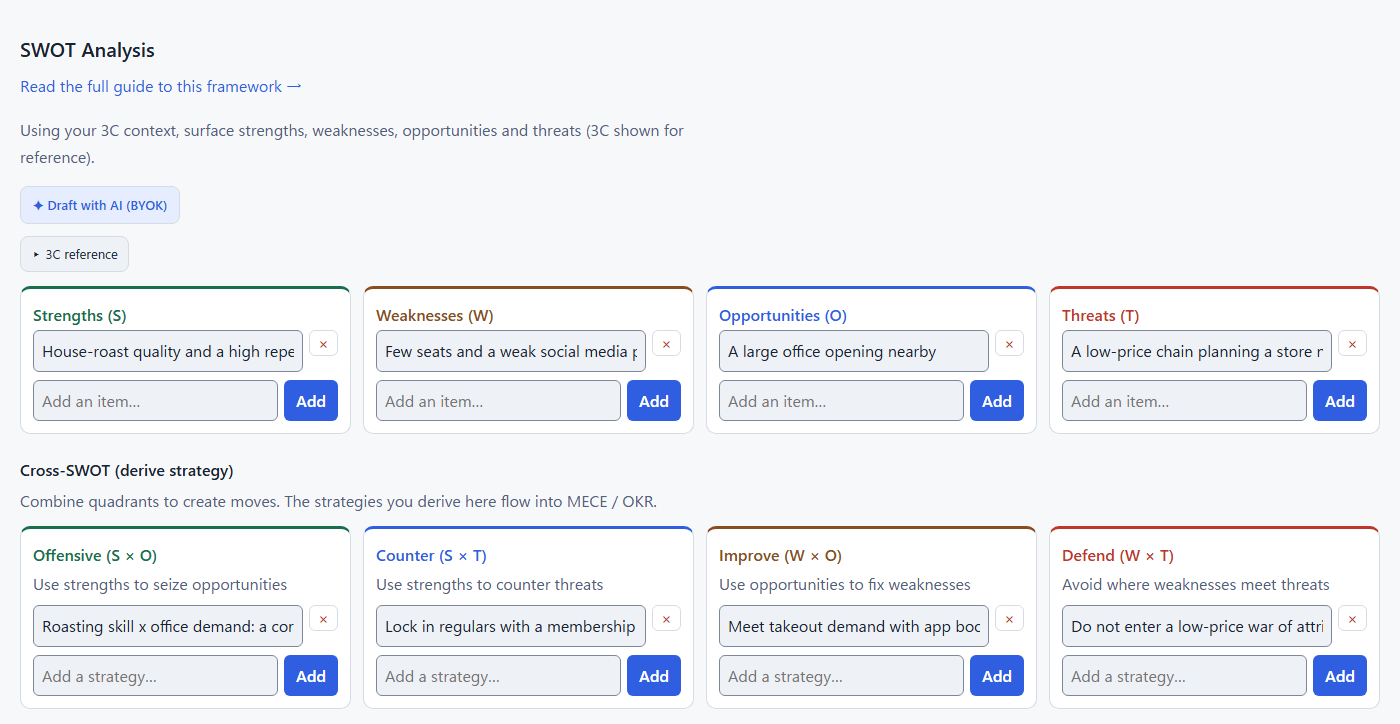
The five-force diagnosis becomes raw material for the external factors of SWOT (Opportunity and Threat). "Many substitutes (4)" and "many competitors (5)" are threats. On the other hand, "a niche where one particular force is weak" is an opportunity.
The key is not to fight a head-on war of attrition in a high-force industry. Avoid the "unfavorable field" the five forces reveal, and use differentiation (self-roasting, experience, community) or focus to pick a spot where the forces bite less — a judgment that flows into the strategy you derive with Cross-SWOT after SWOT.
How it differs from 3C and PEST — players (3C), industry structure (5F), macro (PEST)
All look outward, but from different angles. 3C looks at "individual players" — Customer, Competitor, Company; Five Forces looks at "the structure of the whole industry (the balance of power)"; PEST looks at "the society-wide macro backdrop" like politics and the economy.
The recommendation is to combine them. Capture the big environment with PEST, diagnose the industry's profit structure with Five Forces, and pin down the players in your market with 3C. Funnel all three into SWOT's opportunities and threats for an external analysis with fewer gaps.
Run Five Forces → SWOT → Cross-SWOT → MECE → OKR
Stopping at Five Forces alone tends to leave you having "only diagnosed the industry." Connect the inputs to strategy and action. Gather external inputs with Five Forces (+ 3C, PEST) → organize with SWOT → derive "what to do in this structure" with Cross-SWOT (TOWS) → decompose the issues and prioritize with MECE → land them into measurable OKR targets. That chain turns structural understanding into concrete moves.
This Five Forces → SWOT → Cross-SWOT → MECE → OKR runs on one screen in this strategy cockpit. Everything you enter is stored only on your device (nothing is sent to our servers), and you can try the AI draft in SWOT for free with your own API key (BYOK; you cover only the API usage). A one-time $9.90 purchase unlocks the AI across all frameworks. Daily number tracking can be handed off to the sister app, Baton Board.
FAQ
How do I choose between Five Forces, 3C, and PEST analysis?
Five Forces reads "the structure of the whole industry (the balance of power)," 3C reads "individual players — Customer, Competitor, Company," and PEST reads "the macro backdrop like politics and the economy." The three do not compete; funnel the external picture as PEST (macro) → Five Forces (industry structure) → 3C (players), then gather it into SWOT's opportunities and threats.
When should I use Five Forces?
It is useful when considering entry into a new market, when price competition is fierce and profit is thin, or when rethinking your positioning. You diagnose "is this industry structurally profitable?" and "which force is eroding our profit?" and use that to decide what to avoid and how to differentiate.
What is the weakness of Five Forces?
It is a point-in-time snapshot of industry structure that dates quickly in fast-moving industries, and it "ends at analysis and never becomes action." That is exactly why you convert it to strategy with SWOT and Cross-SWOT, and revisit it with OKR + PDCA to keep it dynamic.
What are the five forces in Five Forces analysis?
Five: ① threat of new entrants ② bargaining power of suppliers ③ bargaining power of buyers ④ threat of substitutes ⑤ rivalry among existing competitors. The stronger the forces, the more profit leaks out of the industry and the harder it is to earn.
Can you give a concrete example of Five Forces?
Take a small café near a station: ① threat of new entrants — high, since opening one has a low barrier. ② supplier power — grows if you depend on a specific rare bean. ③ buyer power — high, since nearby alternatives are plentiful. ④ threat of substitutes — high, from convenience-store coffee and home brewing. ⑤ rivalry — high if many cafés cluster nearby.
Other guides
- How to Do a SWOT Analysis — Complete Guide with Cross-SWOT (TOWS)
- How to Write OKRs — A Practical Guide with Examples
- How to Do a 3C Analysis — Customer, Competitor, Company
- What Is MECE? — Decompose Any Problem Without Gaps or Overlaps
- How to Use the TOWS Matrix (Cross-SWOT) — Turn Four Quadrants into Strategy
- Strategy Frameworks Explained — Use 3C, SWOT, TOWS, MECE and OKRs Together
- KPI vs OKR — the difference, when to use each, and how to connect them
- Turn Strategy into Execution — Running PDCA and Tracking the Daily Numbers (with Baton Board)
- Strategy Frameworks by Industry — 3C→SWOT→OKR Worked Examples for Four Business Types
- The Limits of SWOT Analysis — and How to Complement Them
- What Is PEST Analysis? Read the Macro-Environment and Feed SWOT
- What Is Value Chain Analysis? Break Down Internal Activities and Feed SWOT
- What Is the Ansoff Matrix? Choose a Growth Path by Product × Market and Feed OKR
- What Is a Logic Tree? — Break a Problem Down Branch by Branch (What/Why/How)
- What Is VRIO Analysis? Evaluate Internal Resources with Four Questions and Pick SWOT's Strengths
- What Is STP Marketing? Narrow the Market in Three Steps to Decide Who to Serve
- How to Choose a Strategy Framework — Which One, and When
- What Is the BCG Matrix (PPM)? Allocate Resources Across Businesses in Four Quadrants
- What Is Jobs to Be Done (JTBD)? Finding the "Job" Your Customer Needs Done
- Balanced Scorecard (BSC): four perspectives and a strategy map
- Business Model Canvas (BMC): nine building blocks on one page
Try it right in your browser (free, no signup)
Diagnose industry structure with Five Forces, then move to SWOT → Cross-SWOT → MECE → OKR. One screen; strategy data stays on your device; the SWOT AI draft is free (BYOK).
Open the app →