How to Do a 3C Analysis — the Groundwork Before Any Strategy
3C analysis is the research step most people skip — and skipping it is why their SWOT ends up as a list of hunches. The idea is simple: before deciding anything, look at three things — the Customer, the Competitor, and your own Company. This guide walks each C with a small, concrete example and shows how the findings flow straight into a SWOT and the rest of the strategy cascade.
What 3C is — three lenses on your situation
The 3C analysis, popularized by strategist Kenichi Ohmae, looks at a business through three lenses: Customer (the market and its needs), Competitor (who else serves that need), and Company (your own resources and capabilities). The point is sequence — understand the outside world first, then judge yourself against it.
Each C answers one question. Customer: who needs what, and what will they pay for? Competitor: who are you measured against, and where are they strong? Company: what do you actually have, and what is missing? Skip any one and your later strategy stands on guesswork.
Customer — who needs what, and what do they pay for?
Start outside, with demand. Take a small coffee shop as the running example:
- Who: office workers and students within a few minutes' walk
- What they struggle with: no quiet place to focus between meetings
- What they pay for: fast service, reliable Wi-Fi, a seat they can stay in
- How demand is changing: more remote work, more takeout
Write what customers actually do and pay for, not what you wish they wanted. Talk to a few real ones if you can — five short conversations beat an hour of guessing.
Competitor — who are you compared to, and where are they strong?
Now look sideways. Include both direct competitors (other cafés) and indirect ones (convenience-store coffee, working from home):
- Direct: two chain cafés one block away — cheaper, more seats
- Indirect: convenience-store coffee — far cheaper, no seating
- Their strength: price and consistency
- Their weakness: impersonal, no community
The goal is not to copy competitors but to find the gap they leave open. Note what they are good at (so you don't fight there) and what they neglect (your opening).
Company — what do you have, and what is missing?
Finally, look inward — honestly. Company means your resources, capabilities and constraints, judged against what the customer wants and what competitors do:
- Have: in-house roasting skill, loyal regulars, a spot one minute from the station
- Missing: few seats, no social media, short-staffed
- Can change: hours, menu, how you communicate
- Cannot change (short term): floor space, the rent
Be specific and comparative. 'Good coffee' says little; 'a roast our regulars come back for' is something you can build on. The honest gaps here become your weaknesses in the SWOT.
From 3C to SWOT — turning research into strategy
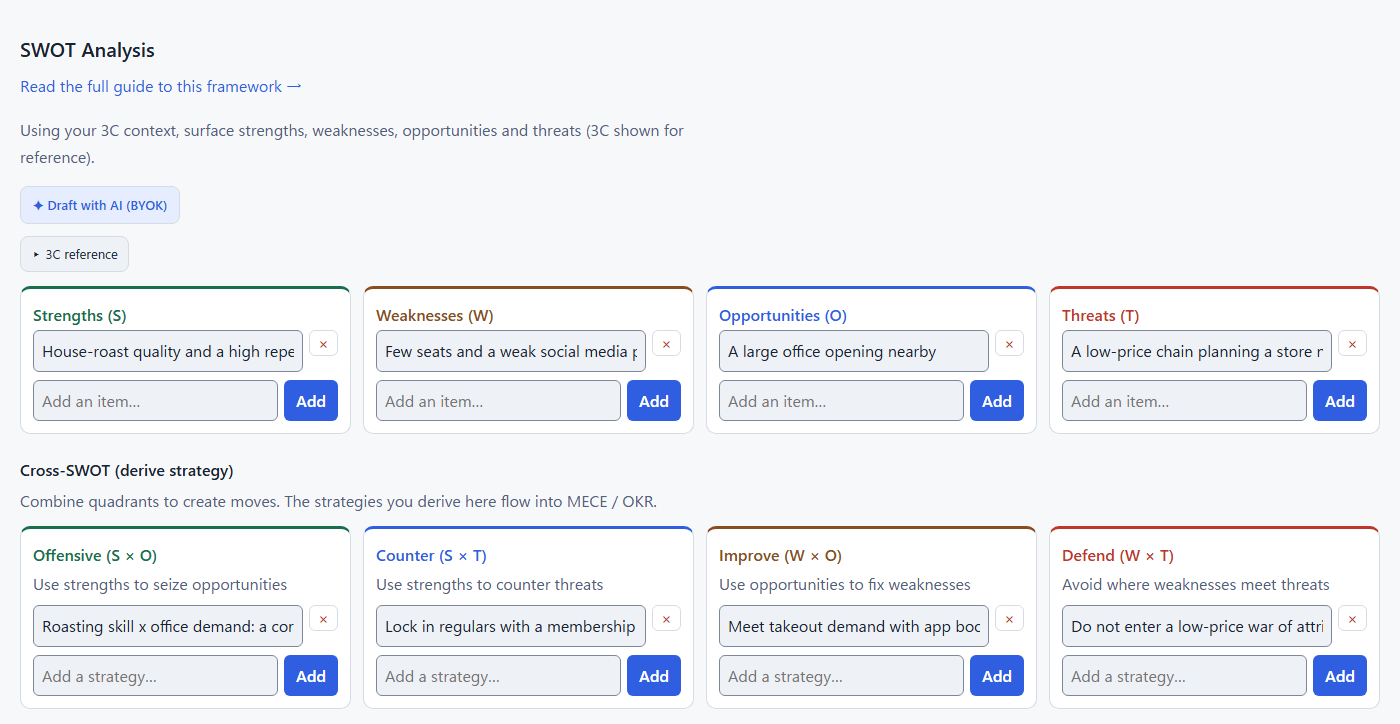
3C is the input, not the answer. The Company-vs-Competitor gap becomes your Strengths and Weaknesses; the Customer and market shifts become your Opportunities and Threats. From there, Cross-SWOT (TOWS) derives actual strategies, MECE breaks them into workstreams, and OKRs make them measurable.
Our strategy cockpit runs this whole cascade — 3C → SWOT → Cross-SWOT → MECE → OKR — on one screen, with each step feeding the next. Everything you type is stored on your device only (nothing is sent to our servers), and the AI drafting assistant is free to try on SWOT — bring your own API key (BYOK); you pay only your provider's usage. Unlocking AI across every framework is a one-time $9.90.
FAQ
What is the difference between 3C and SWOT?
3C is the research step — gathering facts about the customer, competitors and your company. SWOT organizes those facts into internal strengths/weaknesses and external opportunities/threats. Do 3C first; it gives your SWOT evidence instead of guesses.
How is 3C different from 4C or 5C analysis?
The 3C (Customer, Competitor, Company) is the core. Extended versions add lenses like Collaborators/Channel (4C) or Context/Climate (5C). Start with 3C; add more only when a specific decision needs it — boxes you don't use are just busywork.
Do I need real data, or can I estimate?
Start with what you know and mark the guesses. A few real customer conversations and a look at competitors' public prices already beat a blank page. Treat the first 3C as a draft you refine as evidence comes in.
What question does each C — Customer, Competitor, Company — actually answer?
Customer: who is struggling with what, and what will they pay for? Competitor: who are you compared against, and where are they strong? Company: what do you actually have, and what is missing? Answering these three questions in order means the material feeding into SWOT is grounded in fact, not guesswork.
Why does 3C go in the order Customer → Competitor → Company?
Because you should understand the outside world — customer demand and competitor moves — before evaluating yourself against it. Looking at your own company first tends to anchor the analysis on what you want to do, rather than what the market actually needs. Fixing the outside first, then honestly assessing yourself last, keeps the analysis grounded.
Other guides
- How to Do a SWOT Analysis — Complete Guide with Cross-SWOT (TOWS)
- How to Write OKRs — A Practical Guide with Examples
- What Is MECE? — Decompose Any Problem Without Gaps or Overlaps
- How to Use the TOWS Matrix (Cross-SWOT) — Turn Four Quadrants into Strategy
- Strategy Frameworks Explained — Use 3C, SWOT, TOWS, MECE and OKRs Together
- KPI vs OKR — the difference, when to use each, and how to connect them
- Turn Strategy into Execution — Running PDCA and Tracking the Daily Numbers (with Baton Board)
- Strategy Frameworks by Industry — 3C→SWOT→OKR Worked Examples for Four Business Types
- The Limits of SWOT Analysis — and How to Complement Them
- What Is PEST Analysis? Read the Macro-Environment and Feed SWOT
- What Is Porter's Five Forces? Read an Industry's Profit Structure
- What Is Value Chain Analysis? Break Down Internal Activities and Feed SWOT
- What Is the Ansoff Matrix? Choose a Growth Path by Product × Market and Feed OKR
- What Is a Logic Tree? — Break a Problem Down Branch by Branch (What/Why/How)
- What Is VRIO Analysis? Evaluate Internal Resources with Four Questions and Pick SWOT's Strengths
- What Is STP Marketing? Narrow the Market in Three Steps to Decide Who to Serve
- How to Choose a Strategy Framework — Which One, and When
- What Is the BCG Matrix (PPM)? Allocate Resources Across Businesses in Four Quadrants
- What Is Jobs to Be Done (JTBD)? Finding the "Job" Your Customer Needs Done
- Balanced Scorecard (BSC): four perspectives and a strategy map
- Business Model Canvas (BMC): nine building blocks on one page
Try it in your browser — free, no sign-up
3C → SWOT → Cross-SWOT → MECE → OKR on one screen. Fill your 3C and watch it feed the SWOT. Strategy data stays on your device; the AI draft assistant is free on SWOT (with your own API key — BYOK).
Open the app →