The TOWS Matrix (Cross-SWOT) — Four Combinations That Turn Analysis into Strategy
You filled in a SWOT analysis, and then… you were not sure what to do next. This is extremely common. The cause is that SWOT stops at organizing the present and never reaches deriving strategy. The bridge between the two is Cross-SWOT, better known as the TOWS matrix. You combine strengths and weaknesses with opportunities and threats to pull concrete moves out of four directions: S×O, S×T, W×O, and W×T. This guide walks through what TOWS means, how to derive the four strategies, and how to prioritize — using one small café example from start to finish.
What the TOWS matrix is — and how it differs from SWOT
The TOWS matrix was introduced by management scholar Heinz Weihrich in 1982 as a way to convert SWOT into strategy. It uses the same four elements as SWOT, but the goal is different. SWOT lists strengths, weaknesses, opportunities and threats (understanding the present); TOWS combines them to derive the actions you should take (formulating strategy). The name reverses SWOT on purpose: it signals starting from the external environment (opportunities and threats) and responding with the internal (strengths and weaknesses).
Weihrich labeled the four strategies with maxi and mini language. S×O = maxi-maxi (use strengths to maximize opportunities), W×O = mini-maxi (minimize weaknesses while seizing opportunities), S×T = maxi-mini (use strengths to minimize threats), and W×T = mini-mini (minimize both weaknesses and threats). It sounds technical, but the idea is simple: what you should do changes with the combination of what you have and the situation you are in.
First, make your SWOT ready to be combined
The quality of a TOWS matrix is capped by the quality of the SWOT feeding it. Before you combine anything, check that each item meets three conditions: one point per item ("low awareness and short on staff" is two items), a clear comparison basis (strengths and weaknesses only mean something relative to a competitor), and a testable wording ("high repeat rate" beats "high quality"). Combining vague items only produces vague strategy.
If the raw material feels thin, go back to a 3C analysis first (Customer, Competitor, Company). Changes in customers and moves by competitors become your opportunities and threats; the gap between you and rivals becomes your strengths and weaknesses. The stronger that base, the more concrete the four TOWS directions become.
How to derive the four strategies — one café, all the way through
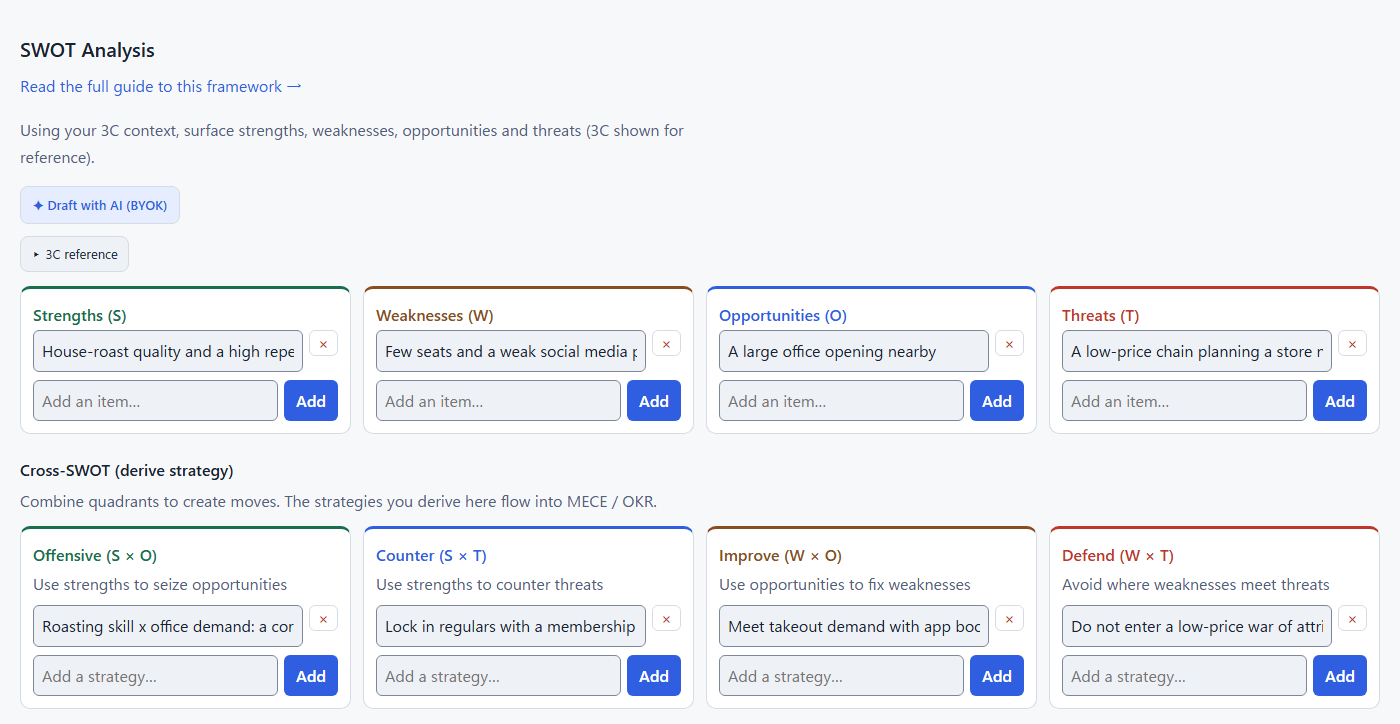
Take a small café and derive four directions of strategy from the same SWOT. Strengths: many regulars, in-house roasting skill, one minute from the station. Weaknesses: few seats, no social media presence, short on staff. Opportunities: a large office opening nearby, takeaway demand becoming permanent. Threats: a low-price chain planning to open, rising ingredient costs.
- S×O (aggressive — go on offense): use strengths to maximize opportunities. "Roasting skill × office opening → launch a corporate coffee subscription." This is the highest-upside quadrant and deserves the most resource.
- S×T (counter — differentiate): use strengths to counter threats. "Regulars base × low-price chain → membership and a roasting experience, so you compete on relationship, not price." Defend with relationship and experience, not discounts.
- W×O (improve — fix the weak spot): use an opportunity to cover a weakness. "No social media × takeaway demand → launch a booking app and start posting at the same time," closing the weakness on the spot. The opportunity becomes the reason to finally fix the gap.
- W×T (defensive — know when not to play): avoid where weakness and threat overlap. "Short on staff × price war → do not enter the low-margin race, and skip late-night hours." This is the quadrant where you decide what NOT to do.
From the same four quadrants, four directions emerged — offense, defense, improvement, and avoidance. Combinations are not strictly one-to-one: a single strength may serve several opportunities, in which case you pick the pairing with the largest effect.
Prioritize — you will not do all of it; use W×T to decide what to drop
Even when TOWS gives you four directions, you must not execute them all at once, because resources — people, time, money — are limited. A useful order: concentrate resource on S×O (the biggest upside) first, shore up your footing with S×T (defense) next, and let W×O (improvement) ride along on the opportunity.
It is easy to overlook, but the hidden value of TOWS is in W×T. W×T is usually not "something new to do" but "something to decide not to do." Choosing to stay out of the zone where weakness and threat overlap concentrates limited resource on where you can grow. Strategy is as much about what you will not do as what you will.
Pass the strategy forward — break it down with MECE, measure it with OKRs
A strategy derived from TOWS is still at the grain of a "direction." To execute "a corporate coffee subscription," for example, break the issues down with MECE (mutually exclusive, collectively exhaustive): "prospecting," "product and pricing design," and "delivery operations" — no overlaps, no gaps — then set numeric OKR targets on each (e.g., pitch 10 companies in month one; two products with cost ratio under 40%).
Our strategy cockpit is built to run exactly this 3C → SWOT → Cross-SWOT → MECE → OKR flow on one screen. Each step’s output is referenced as the next step’s input, and everything you type is stored only on your own device (nothing is sent to our servers). In SWOT you can try AI drafting for free (BYOK — bring your own API key; you only pay your provider’s usage). Using AI across every framework is a one-time $9.90 purchase.
FAQ
Are Cross-SWOT and the TOWS matrix the same thing?
Yes — they refer to the same method: a framework that combines the SWOT quadrants to derive strategy, systematized by Heinz Weihrich in 1982 as the "TOWS matrix." "Cross-SWOT" is simply a common alternative name; the substance is identical.
Which of the four quadrants should I start with?
Start with S×O (strengths × opportunities). It has the greatest upside and builds momentum. Then fill S×T and W×O, and finish with W×T to decide what NOT to do — that sequence gives the whole plan a clear emphasis.
What if I derive too many strategies to choose from?
Rank them on two axes — size of impact × ease of execution — and start from the top-right (high impact, easy). If there are still too many, do not spread resource thin: concentrate on one or two S×O moves first. Naming what you will NOT do in W×T is another effective way to narrow the list.
What do S×O, S×T, W×O, and W×T each mean?
S×O (aggressive growth) uses a strength to maximize an opportunity. S×T (differentiate) uses a strength to counter a threat. W×O (improve) uses an opportunity to shore up a weakness. W×T (defend) avoids the overlap of a weakness and a threat — often a decision about what not to do. Weihrich framed these as maxi-maxi, mini-maxi, maxi-mini, and mini-mini.
How do I sharpen SWOT before running it through TOWS?
Check that every item in each quadrant is one point per line, has a clear point of comparison, and is stated in a verifiable way. Multiplying vague items together only produces a vague strategy. If the material feels thin, go back to 3C analysis (Customer, Competitor, Company) first to firm up the SWOT before running TOWS.
Other guides
- How to Do a SWOT Analysis — Complete Guide with Cross-SWOT (TOWS)
- How to Write OKRs — A Practical Guide with Examples
- How to Do a 3C Analysis — Customer, Competitor, Company
- What Is MECE? — Decompose Any Problem Without Gaps or Overlaps
- Strategy Frameworks Explained — Use 3C, SWOT, TOWS, MECE and OKRs Together
- KPI vs OKR — the difference, when to use each, and how to connect them
- Turn Strategy into Execution — Running PDCA and Tracking the Daily Numbers (with Baton Board)
- Strategy Frameworks by Industry — 3C→SWOT→OKR Worked Examples for Four Business Types
- The Limits of SWOT Analysis — and How to Complement Them
- What Is PEST Analysis? Read the Macro-Environment and Feed SWOT
- What Is Porter's Five Forces? Read an Industry's Profit Structure
- What Is Value Chain Analysis? Break Down Internal Activities and Feed SWOT
- What Is the Ansoff Matrix? Choose a Growth Path by Product × Market and Feed OKR
- What Is a Logic Tree? — Break a Problem Down Branch by Branch (What/Why/How)
- What Is VRIO Analysis? Evaluate Internal Resources with Four Questions and Pick SWOT's Strengths
- What Is STP Marketing? Narrow the Market in Three Steps to Decide Who to Serve
- How to Choose a Strategy Framework — Which One, and When
- What Is the BCG Matrix (PPM)? Allocate Resources Across Businesses in Four Quadrants
- What Is Jobs to Be Done (JTBD)? Finding the "Job" Your Customer Needs Done
- Balanced Scorecard (BSC): four perspectives and a strategy map
- Business Model Canvas (BMC): nine building blocks on one page
Try it right in your browser — free, no sign-up
3C → SWOT → Cross-SWOT → MECE → OKR on one screen. Go from the four SWOT quadrants to the four TOWS strategies in place. Strategy data stays on your device; AI in SWOT is free (bring your own API key — BYOK).
Open the app →