What Is VRIO Analysis? Sorting Internal Resources into Sustained Strengths
VRIO analysis is an internal-analysis framework that runs your resources and capabilities through four questions in order — Value, Rarity, Imitability, and Organization — to tell whether an advantage is temporary or sustained. Management scholar Jay Barney set it out within the resource-based view (RBV), refining the earlier VRIN (1991). Where the value chain surfaces "which activities create value," VRIO sifts for "which resources actually last as strengths." That lets you pick SWOT's strengths by durability, not by hunch. This guide explains the four questions, how it differs from other analyses, and how to connect it to SWOT, using a café example.
What VRIO analysis is — evaluating internal resources with four questions
VRIO runs your resources (skills, location, brand, people, customer base, and so on) through four questions in order to judge how much competitive advantage each yields. The order is "is it valuable → is it rare → is it hard to imitate → is the firm organized to use it," and each later question raises the bar.
The point is to look not at "whether you have a resource" but at "whether it leads to a sustained advantage." A resource anyone can obtain does not differentiate you, even if it is valuable. Only a resource that clears all four becomes a hard-to-copy, sustained strength.
Walking the four questions (V, R, I, O) in order (a café example)
Take a small café near a station and run one resource through the four questions.
- Value: does the resource help you seize an opportunity or soften a threat? E.g., self-roasting skill differentiates on "taste," so it is valuable. If it does not help, that resource is a source of competitive disadvantage.
- Rarity: do only a few hold it? E.g., a common espresso machine found in every shop is not rare — that is parity. Self-roasting craft that is scarce nearby is rare.
- Imitability: is it costly or slow to copy? Years of tacit know-how, a unique history, and social complexity (relationships with regulars) make a resource hard to imitate.
- Organization: are the systems and structure in place to capture that value? Even a skilled barista lets value slip away without training and clear roles.
The decision flow: feeding VRIO into SWOT's "strengths"
The four answers set the level of advantage a resource yields. Not valuable = competitive disadvantage. Valuable but not rare = competitive parity (a baseline everyone shares). Valuable and rare but easy to imitate = a temporary advantage. Valuable, rare, and hard to imitate but not organized = an unused, potential advantage. Clears all four = a sustained competitive advantage.
Feed that verdict straight into SWOT's "strengths." A resource that yields a sustained advantage (e.g., self-roasting skill plus a regulars community) is a real strength. A parity-only resource is "a baseline you are expected to have" and is weak as a differentiating strength. A missing resource is written as a weakness. The value chain surfaces candidate strengths and VRIO sifts the lasting ones from among them — those two steps make SWOT's strengths concrete and durable.
How it differs from value chain, 3C, PEST, and Five Forces — internal and external as two wheels
VRIO and the value chain both look "inside." The value chain breaks activities down to surface candidate strengths and weaknesses; VRIO judges, with four questions, whether the resource is a sustained advantage. The natural order is: surface candidates with the value chain → sift them with VRIO → SWOT's strengths.
By contrast, 3C (players), Five Forces (industry structure), and PEST (macro) look "outside" and feed opportunities and threats (O/T). The recommendation is to use both wheels: surface opportunities and threats with the external set, and strengths and weaknesses with the internal one (value chain plus VRIO). Funnel both into SWOT for a balanced, inside-and-outside read of where you stand.
Run VRIO → SWOT → Cross-SWOT → MECE → OKR
Stopping at VRIO alone tends to leave you having "only graded resources." Connect the inputs to strategy and action. Pin down sustained strengths with VRIO (+ break down activities with the value chain; external via PEST/Five Forces/3C) → organize with SWOT → derive "where to apply your strengths" with Cross-SWOT (TOWS) → decompose the issues and prioritize with MECE → land them into measurable OKR targets. That chain turns the evaluation of resources into concrete moves.
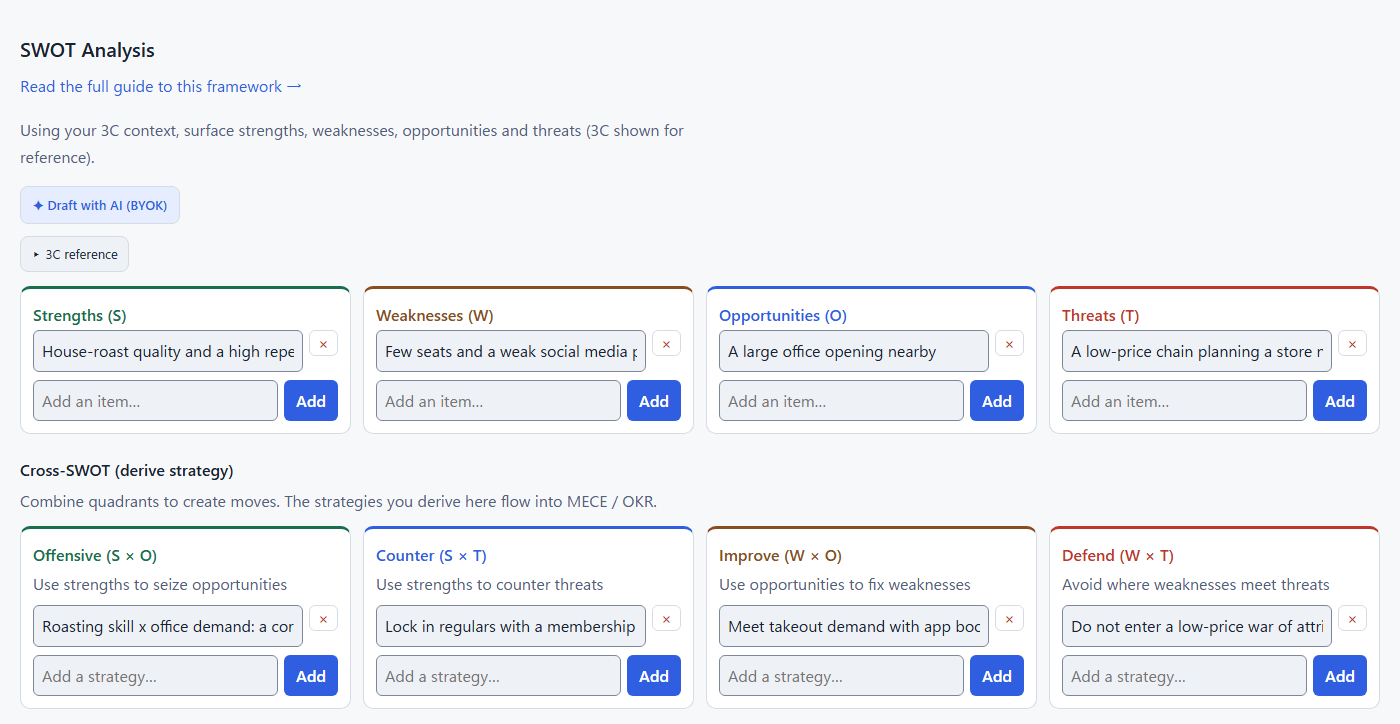
This VRIO → SWOT → Cross-SWOT → MECE → OKR runs on one screen in this strategy cockpit. Everything you enter is stored only on your device (nothing is sent to our servers), and you can try the AI draft in SWOT for free with your own API key (BYOK; you cover only the API usage). A one-time $9.90 purchase unlocks the AI across all frameworks. Daily number tracking can be handed off to the sister app, Baton Board.
FAQ
How do I choose between VRIO and value chain analysis?
Both are internal analysis, but their jobs differ. The value chain is a tool to break activities down and surface candidate strengths and weaknesses; VRIO is a tool to judge whether a resource clears Value, Rarity, Imitability, and Organization to become a sustained advantage. Use them in two steps: surface candidates with the value chain, sift them with VRIO, and feed SWOT's strengths.
What are the four questions of VRIO?
Value (does it help seize an opportunity or soften a threat?), Rarity (do only a few hold it?), Imitability (is it costly to copy?), and Organization (is the structure in place to capture the value?). Ask them in that order; a resource that clears all four becomes a sustained competitive advantage.
What is the weakness of VRIO analysis?
It is a point-in-time evaluation of internal resources and is not a move on its own. It also ignores the external environment (market, competitors, macro), so you need to combine it with external analysis (3C, Five Forces, PEST). That is why you convert it to strategy with SWOT and Cross-SWOT and land it into measurable OKR targets.
How do you judge a resource that doesn't clear all four questions?
Judge it in stages. Not valuable = competitive disadvantage. Valuable but not rare = competitive parity (a shared baseline). Valuable and rare but easy to imitate = a temporary advantage. Valuable, rare, and hard to imitate but not organized = an unused, potential advantage. Only clearing all four = a sustained competitive advantage.
When was VRIO devised?
Management scholar Jay Barney set it out within the resource-based view (RBV), refining the earlier VRIN framework (1991).
Other guides
- How to Do a SWOT Analysis — Complete Guide with Cross-SWOT (TOWS)
- How to Write OKRs — A Practical Guide with Examples
- How to Do a 3C Analysis — Customer, Competitor, Company
- What Is MECE? — Decompose Any Problem Without Gaps or Overlaps
- How to Use the TOWS Matrix (Cross-SWOT) — Turn Four Quadrants into Strategy
- Strategy Frameworks Explained — Use 3C, SWOT, TOWS, MECE and OKRs Together
- KPI vs OKR — the difference, when to use each, and how to connect them
- Turn Strategy into Execution — Running PDCA and Tracking the Daily Numbers (with Baton Board)
- Strategy Frameworks by Industry — 3C→SWOT→OKR Worked Examples for Four Business Types
- The Limits of SWOT Analysis — and How to Complement Them
- What Is PEST Analysis? Read the Macro-Environment and Feed SWOT
- What Is Porter's Five Forces? Read an Industry's Profit Structure
- What Is Value Chain Analysis? Break Down Internal Activities and Feed SWOT
- What Is the Ansoff Matrix? Choose a Growth Path by Product × Market and Feed OKR
- What Is a Logic Tree? — Break a Problem Down Branch by Branch (What/Why/How)
- What Is STP Marketing? Narrow the Market in Three Steps to Decide Who to Serve
- How to Choose a Strategy Framework — Which One, and When
- What Is the BCG Matrix (PPM)? Allocate Resources Across Businesses in Four Quadrants
- What Is Jobs to Be Done (JTBD)? Finding the "Job" Your Customer Needs Done
- Balanced Scorecard (BSC): four perspectives and a strategy map
- Business Model Canvas (BMC): nine building blocks on one page
Try it right in your browser (free, no signup)
Sift internal resources into sustained strengths with VRIO, then move to SWOT → Cross-SWOT → MECE → OKR. One screen; strategy data stays on your device; the SWOT AI draft is free (BYOK).
Open the app →