How to Do a SWOT Analysis — and Turn It into Strategy, Not Just a Chart
Most SWOT analyses end as a chart nobody acts on. Two habits cause this: skipping the research step (starting to write without inputs), and stopping after the four quadrants instead of converting them into strategy with Cross-SWOT (TOWS). This guide walks the full path — collect inputs with 3C, organize with SWOT, derive actions with TOWS — using a small, concrete example throughout.
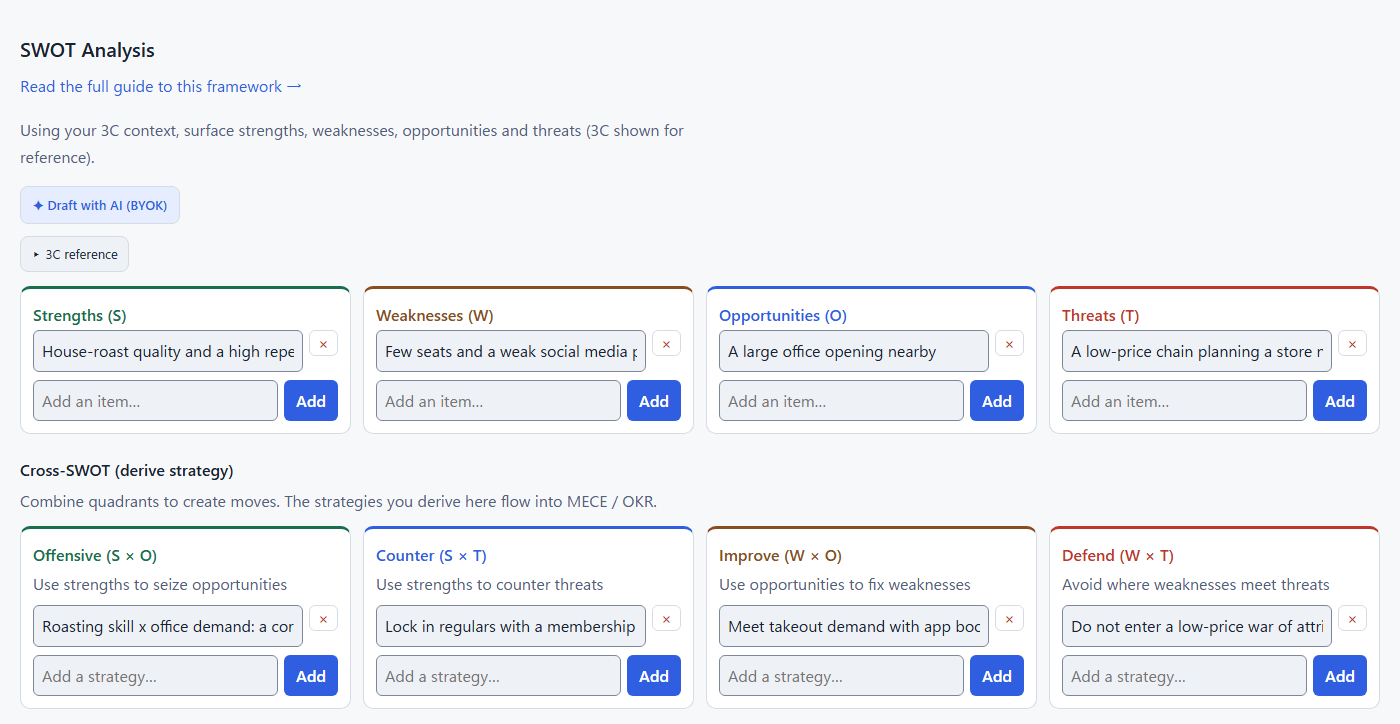
What SWOT actually means — internal vs. external
SWOT organizes your situation into internal factors — Strengths and Weaknesses — and external factors — Opportunities and Threats. The internal/external split is the load-bearing idea: things you can change (people, technology, cash, brand) are internal; things you cannot (market shifts, competitor moves, regulation, the economy) are external.
The most common mistake is writing your own intentions in the Opportunities box ("launch a new product line"). An opportunity is a change in the outside world — "a large office complex is opening nearby" is an opportunity; the product you launch in response is a strategy.
Step 0: Gather inputs with a 3C analysis
Starting SWOT cold produces a list of hunches. Write a short 3C first — Customer, Competitor, Company — and every quadrant gains evidence behind it.
Customer: who is struggling with what, and what do they pay for? Competitor: who are you compared against, and what are they good at? Company: what do you have, and what are you missing? Strengths and weaknesses fall out of the company-vs-competitor gap; opportunities and threats fall out of customer and market change.
Step 1: Fill the four quadrants — example and three rules
Take a small coffee shop as the running example:
- Strengths: loyal regulars / in-house roasting skill / one minute from the station
- Weaknesses: few seats / no social media presence / short-staffed
- Opportunities: a large office complex opening nearby / takeout demand here to stay
- Threats: a discount chain planning a store / rising ingredient costs
Three rules: (1) one item, one point — "low awareness and short-staffed" is two items; (2) pick a comparison target — strengths and weaknesses only mean something relative to a competitor; (3) write verifiable statements — "high repeat rate" beats "great quality".
Step 2: Convert analysis into strategy with Cross-SWOT (TOWS)
This is where the real value starts. Combine the quadrants in four directions:
- S×O (leverage): use strengths to seize opportunities — "roasting skill × office complex → B2B coffee subscription"
- S×T (counter): use strengths against threats — "loyal base × discount chain → membership program"
- W×O (improve): use opportunities to fix weaknesses — "no social media × takeout demand → launch ordering app and start posting together"
- W×T (defend): avoid where weakness meets threat — "short-staffed × price war → do not enter the low-price fight"
You do not need to pursue all four. Deciding what not to do (the W×T quadrant) is often the highest-value output, because it concentrates limited resources. In the app, these four directions appear under their universal letters: S×O, S×T, W×O and W×T.
Step 3: Break strategy down with MECE, then make it measurable with OKRs
A derived strategy is still a direction, not a plan. Decompose it with MECE (mutually exclusive, collectively exhaustive) into workstreams, then attach measurable Key Results. For the B2B subscription: "prospecting", "product design", "delivery operations" — each with numbers like "pitch 10 companies in month one".
Our strategy cockpit was built to run this exact cascade — 3C → SWOT → Cross-SWOT → MECE → OKR — on one screen, with each step feeding the next. Everything you type is stored on your device only (nothing is sent to our servers), and the AI drafting assistant is free to try on SWOT — bring your own API key (BYOK); you pay only your provider's usage.
FAQ
When should I use a SWOT analysis?
At the start of a new business or product, during annual planning, or when the environment shifts (a new competitor, new regulation). Any time you need to inventory your situation split by internal and external factors.
What is the difference between SWOT and Cross-SWOT (TOWS)?
SWOT organizes the current situation; Cross-SWOT derives strategy by combining the quadrants. Stopping at SWOT is why most analyses produce no action — treat them as one exercise.
Does SWOT work for individuals and small teams?
Yes — arguably better. The scarcer your resources, the more valuable the W×T decision of what not to do. The small-shop example in this guide is exactly that scale.
What are the most common mistakes in a SWOT analysis?
The two most common mistakes are: skipping the material-gathering step (3C analysis) and jumping straight into writing, which produces an off-the-cuff list; and stopping after filling in the four quadrants instead of converting them into a Cross-SWOT, so the analysis stays "written but never acted on." Another frequent mistake is writing something your own company wants to do (e.g., "launch a new product") in the Opportunities box — an opportunity is a change in the external environment, not your own intention.
Can you give a concrete example of a SWOT analysis?
Using a small café as an example: Strengths — many regulars, in-house roasting skill, one minute from the station. Weaknesses — few seats, no social media presence, understaffed. Opportunities — a large office building opening nearby, take-out demand becoming permanent. Threats — a discount chain planning to open, rising raw material costs. See "Step 1" in this guide for the full walkthrough.
Other guides
- How to Write OKRs — A Practical Guide with Examples
- How to Do a 3C Analysis — Customer, Competitor, Company
- What Is MECE? — Decompose Any Problem Without Gaps or Overlaps
- How to Use the TOWS Matrix (Cross-SWOT) — Turn Four Quadrants into Strategy
- Strategy Frameworks Explained — Use 3C, SWOT, TOWS, MECE and OKRs Together
- KPI vs OKR — the difference, when to use each, and how to connect them
- Turn Strategy into Execution — Running PDCA and Tracking the Daily Numbers (with Baton Board)
- Strategy Frameworks by Industry — 3C→SWOT→OKR Worked Examples for Four Business Types
- The Limits of SWOT Analysis — and How to Complement Them
- What Is PEST Analysis? Read the Macro-Environment and Feed SWOT
- What Is Porter's Five Forces? Read an Industry's Profit Structure
- What Is Value Chain Analysis? Break Down Internal Activities and Feed SWOT
- What Is the Ansoff Matrix? Choose a Growth Path by Product × Market and Feed OKR
- What Is a Logic Tree? — Break a Problem Down Branch by Branch (What/Why/How)
- What Is VRIO Analysis? Evaluate Internal Resources with Four Questions and Pick SWOT's Strengths
- What Is STP Marketing? Narrow the Market in Three Steps to Decide Who to Serve
- How to Choose a Strategy Framework — Which One, and When
- What Is the BCG Matrix (PPM)? Allocate Resources Across Businesses in Four Quadrants
- What Is Jobs to Be Done (JTBD)? Finding the "Job" Your Customer Needs Done
- Balanced Scorecard (BSC): four perspectives and a strategy map
- Business Model Canvas (BMC): nine building blocks on one page
Try it in your browser — free, no sign-up
3C → SWOT → Cross-SWOT → MECE → OKR on one screen. Strategy data stays on your device; the AI draft assistant is free on SWOT (with your own API key — BYOK).
Open the app →