The Limits of SWOT Analysis — and How to Complement Them
SWOT is one of the world's most-used frameworks, yet it draws persistent criticism: "nothing gets decided," "everyone fills it differently." In fact, in 1997 Terry Hill and Roy Westbrook, in "SWOT Analysis: It's Time for a Product Recall," argued that SWOT tends to produce long, unstructured lists. But most criticism traces to using SWOT on its own. This guide lays out the common limits and how to complement them so SWOT actually works in practice.
Five commonly cited limits of SWOT
Here are the classic criticisms. Each says less "SWOT is bad" and more "SWOT alone is not enough."
- 1. It ends at analysis and never becomes action (you fill four quadrants but no move comes out).
- 2. It is subjective and unevidenced (items change by person and cannot be verified).
- 3. It gives no prioritization (every item looks equal; you cannot tell what matters).
- 4. It is a static snapshot (a point-in-time list that does not track a changing environment).
- 5. It tends to confuse internal and external factors (you write your intentions as "opportunities").
Fixing limit 1: convert to strategy with Cross-SWOT (TOWS)
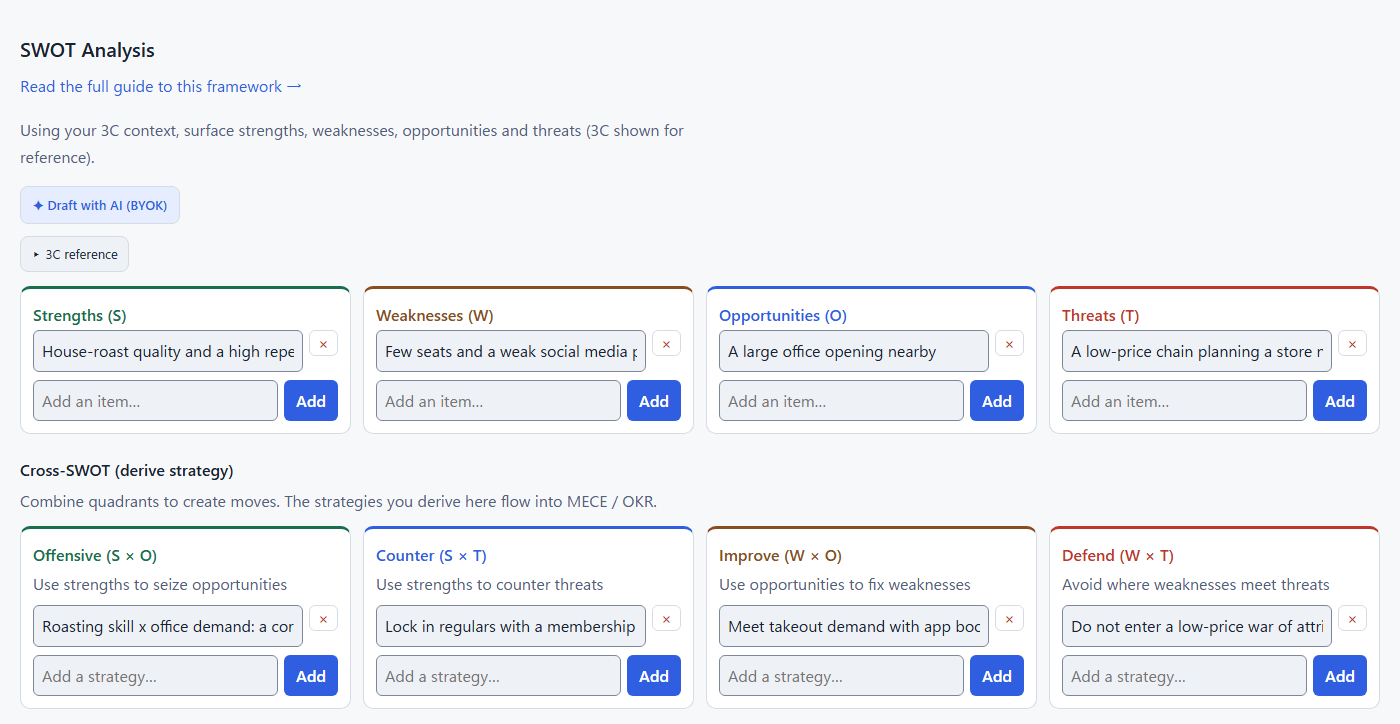
The biggest criticism — "it ends as a chart" — dissolves when you add Cross-SWOT (TOWS) after SWOT. Cross the quadrants to derive concrete strategy from four directions: S×O (strengths seize opportunities), S×T (strengths counter threats), W×O (opportunities offset weaknesses), W×T (avoid where weakness meets threat).
SWOT is "organizing the present"; Cross-SWOT is "deriving strategy." Stopping at organization yields no move, so always pair them.
Fixing limits 2 and 5: gather inputs first with 3C, and split internal/external strictly
The "subjective" charge comes from starting SWOT cold. Write a 3C first (Customer, Competitor, Company) and each quadrant gains evidence: strengths/weaknesses come from the company-vs-competitor gap, opportunities/threats from customer and market change — no more list of hunches.
The internal/external mix-up is prevented by one rule. What you can change (people, tech, cash, brand) = internal = strengths/weaknesses; what you cannot (market, competitors, regulation, the economy) = external = opportunities/threats. "A big store opens nearby" is an opportunity; "launch a rival product" is the strategy in response.
Fixing limits 3 and 4: prioritize with MECE, stay dynamic with PDCA
"No prioritization" is solved by decomposing the derived strategy with MECE (no gaps, no overlaps) and using W×T to decide what NOT to do. Rather than doing everything, concentrating resources on one or two directions covers this weakness.
The "static" charge is solved by not treating SWOT as one-off. Land it into measurable OKR targets and revisit with PDCA (Plan-Do-Check-Act), and a point-in-time photo becomes a moving strategy. Daily number tracking can be handed off to the sister app, Baton Board.
Do not discard SWOT — complement it, end to end
In short, SWOT's limits are the limits of using it alone, and adding the steps before and after fills nearly all of them. 3C for inputs (fixes 2 and 5) → SWOT to organize → Cross-SWOT for strategy (fixes 1) → MECE for priority (fixes 3) → OKR + PDCA to stay dynamic (fixes 4). That chain is the practical answer to the criticism.
This 3C→SWOT→Cross-SWOT→MECE→OKR runs on one screen in this strategy cockpit. Everything you enter is stored only on your device (nothing is sent to our servers), and you can try the AI draft in SWOT for free with your own API key (BYOK; you cover only the API usage). A one-time $9.90 purchase unlocks the AI across all frameworks.
FAQ
Is SWOT analysis outdated or useless now?
It is not outdated. Most criticism targets using SWOT on its own. Gather inputs with 3C, convert to strategy with Cross-SWOT, and add prioritization and measurement with MECE/OKR, and it still works well in practice.
What is SWOT's biggest weakness?
That it "ends at analysis and never becomes action." Filling four quadrants yields no move. Always add the step that crosses the quadrants with Cross-SWOT (TOWS) to convert them into concrete strategy.
What should I complement SWOT with?
Before it, 3C (gathering evidence); after it, Cross-SWOT (strategy), MECE (priority), and OKR + PDCA (measure and update). Adding both ends dissolves the main criticisms — subjectivity, no action, no priority, and being static.
What paper pointed out the limitations of SWOT?
In 1997, Terry Hill and Roy Westbrook published "SWOT Analysis: It's Time for a Product Recall," arguing that SWOT tends to produce long, unstructured lists. That criticism, though, stems from using SWOT alone — pairing it with the steps before and after makes it work well in practice.
How do you avoid mixing up internal and external factors?
Fix one rule: what your company can change (people, skills, funds, brand) is internal — strengths/weaknesses; what it can't change (market, competitors, regulation, the economy) is external — opportunities/threats. "A large store opening nearby" is an opportunity; "launch a competing product" is the strategy that responds to it.
Other guides
- How to Do a SWOT Analysis — Complete Guide with Cross-SWOT (TOWS)
- How to Write OKRs — A Practical Guide with Examples
- How to Do a 3C Analysis — Customer, Competitor, Company
- What Is MECE? — Decompose Any Problem Without Gaps or Overlaps
- How to Use the TOWS Matrix (Cross-SWOT) — Turn Four Quadrants into Strategy
- Strategy Frameworks Explained — Use 3C, SWOT, TOWS, MECE and OKRs Together
- KPI vs OKR — the difference, when to use each, and how to connect them
- Turn Strategy into Execution — Running PDCA and Tracking the Daily Numbers (with Baton Board)
- Strategy Frameworks by Industry — 3C→SWOT→OKR Worked Examples for Four Business Types
- What Is PEST Analysis? Read the Macro-Environment and Feed SWOT
- What Is Porter's Five Forces? Read an Industry's Profit Structure
- What Is Value Chain Analysis? Break Down Internal Activities and Feed SWOT
- What Is the Ansoff Matrix? Choose a Growth Path by Product × Market and Feed OKR
- What Is a Logic Tree? — Break a Problem Down Branch by Branch (What/Why/How)
- What Is VRIO Analysis? Evaluate Internal Resources with Four Questions and Pick SWOT's Strengths
- What Is STP Marketing? Narrow the Market in Three Steps to Decide Who to Serve
- How to Choose a Strategy Framework — Which One, and When
- What Is the BCG Matrix (PPM)? Allocate Resources Across Businesses in Four Quadrants
- What Is Jobs to Be Done (JTBD)? Finding the "Job" Your Customer Needs Done
- Balanced Scorecard (BSC): four perspectives and a strategy map
- Business Model Canvas (BMC): nine building blocks on one page
Try it right in your browser (free, no signup)
Do not let SWOT "end as a chart." 3C→SWOT→Cross-SWOT→MECE→OKR on one screen; strategy data stays on your device; the SWOT AI draft is free (BYOK).
Open the app →