What Is MECE? — Breaking Problems Down Without Gaps or Overlaps
MECE — Mutually Exclusive, Collectively Exhaustive — is the discipline behind every clear issue tree. It means splitting a problem into parts that don't overlap (mutually exclusive) and together cover everything that matters (collectively exhaustive). Done well, it turns a vague strategy into a checklist you can actually assign and measure. This guide shows how to build a MECE tree, how to run the two checks, and the mistakes to avoid — with a concrete example.
What MECE means — two rules, one clean tree
MECE was popularized at McKinsey (it underpins Barbara Minto's Pyramid Principle). It has two halves. Mutually Exclusive: each branch is distinct — no item belongs in two places at once. Collectively Exhaustive: the branches together leave nothing important out. ME keeps you from double-counting; CE keeps you from missing something.
The payoff is that a MECE breakdown can be divided among people, tracked, and turned into goals — without arguments about who owns what or the fear that a whole area was forgotten.
How to build a MECE tree — one axis per level
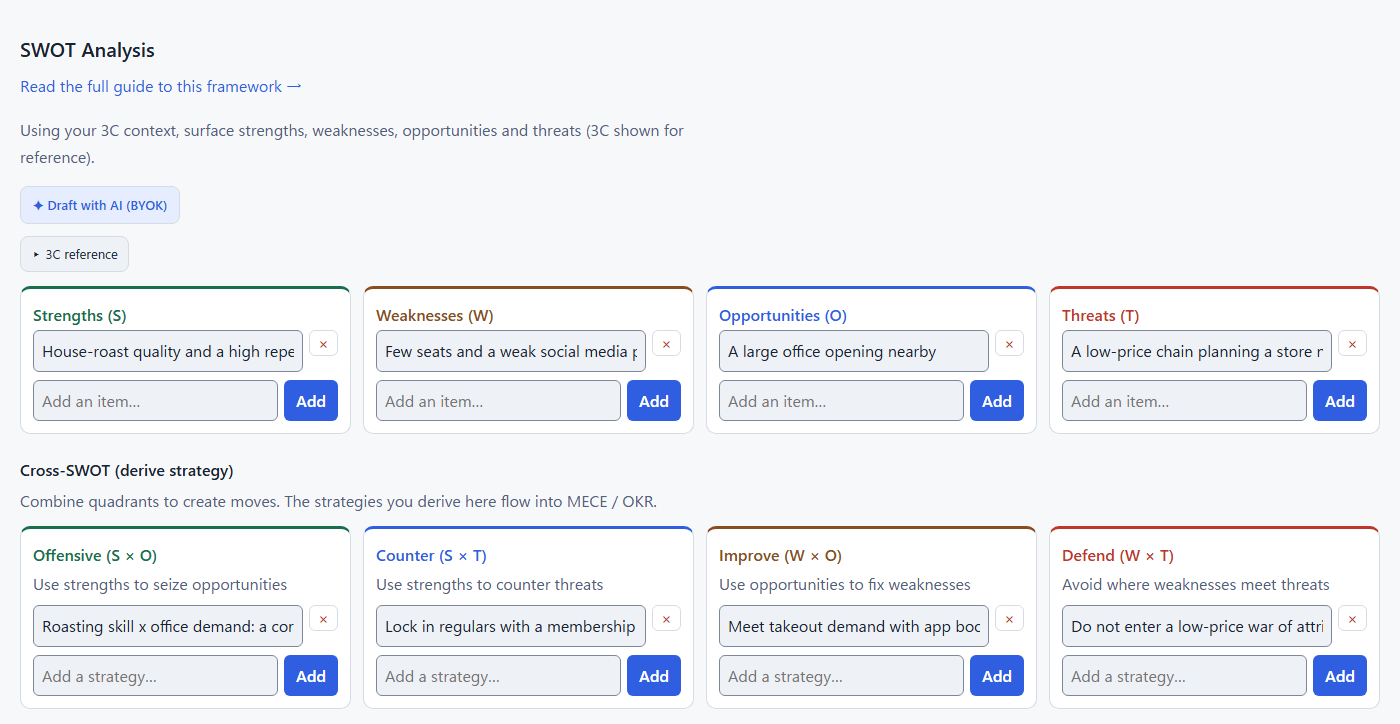
The key trick: at each level, split by a single, consistent axis. Take the strategy 'launch a B2B coffee subscription' (the output of the earlier SWOT and Cross-SWOT) and break it down:
- Customer acquisition — how prospects find and sign up
- Product & pricing — what's in the plan and what it costs
- Delivery operations — how coffee reaches the office reliably
These three don't overlap (a task belongs to exactly one) and together cover the whole launch. If you mixed axes — say, 'acquisition, pricing, and social media' — you'd get overlaps and gaps, because social media is part of acquisition, not a peer of it.
The ME check — do the branches overlap?
Read the siblings at each level and ask: could the same task honestly sit under two of them? If yes, the split isn't mutually exclusive. Common overlaps: 'online vs. mobile' (mobile is online), 'new customers vs. young customers' (a young new customer fits both).
In the app, the MECE view flags duplicate sibling text to help you catch the most obvious overlaps — but the judgment of whether two differently-worded items mean the same thing is still yours.
The CE check — is anything important missing?
Now ask the opposite: if every branch succeeded, would the parent be fully handled — or is there a gap? For the subscription, 'acquisition + product + delivery' — what about billing and support after the sale? If that matters, it's a missing branch.
A useful trick for CE is to add a deliberate 'everything else / other' branch while drafting. If it keeps filling up, you're missing a real category — name it.
From MECE to OKR — making the branches measurable
A MECE tree is still a structure, not a plan. Each branch becomes a place to attach a goal: turn 'customer acquisition' into an Objective with measurable Key Results, and so on. Because the tree is exhaustive, you know your goals cover the whole strategy; because it's exclusive, no two goals fight over the same work.
Our strategy cockpit runs this whole cascade — 3C → SWOT → Cross-SWOT → MECE → OKR — on one screen, with each step feeding the next. The MECE view lets you build the tree, flags duplicate siblings, and hands the branches to the OKR step. Everything you type is stored on your device only (nothing is sent to our servers), and the AI drafting assistant is free to try on SWOT — bring your own API key (BYOK); you pay only your provider's usage. Unlocking AI across every framework is a one-time $9.90.
FAQ
What does MECE stand for?
Mutually Exclusive, Collectively Exhaustive. Mutually exclusive means the parts don't overlap; collectively exhaustive means they cover everything important. Together they make a clean, complete breakdown of a problem.
What are common ways to split something MECE?
By process step (first → last), by category (type A / B / C), by segment (customer groups), or by a formula (e.g. revenue = price × quantity). Pick one axis per level and stay consistent, and the split tends to come out MECE.
Does everything have to be perfectly MECE?
No — MECE is a tool for clarity, not a law. For a quick decision, roughly MECE is fine. Invest in a strict tree when the breakdown will be divided among people or turned into goals, where overlaps and gaps cause real problems.
How do I run the ME check and the CE check?
For the ME (Mutually Exclusive) check, look at the siblings at each level and ask: could the same task honestly sit under two of them? If so, the split overlaps and needs reworking. For the CE (Collectively Exhaustive) check, ask the reverse: if every branch succeeded, would the parent be fully covered, or is there a gap? Deliberately adding an "other" branch while drafting helps surface anything you overlooked.
What other frameworks does MECE get combined with?
Strategic material typically comes in from Cross-SWOT (TOWS), MECE then decomposes the issues with no gaps or overlaps, and each branch is turned into a measurable OKR target. MECE alone is structure, not a plan — pairing it with the framework before it (deriving strategy) and after it (OKR) is what turns it into something executable.
Other guides
- How to Do a SWOT Analysis — Complete Guide with Cross-SWOT (TOWS)
- How to Write OKRs — A Practical Guide with Examples
- How to Do a 3C Analysis — Customer, Competitor, Company
- How to Use the TOWS Matrix (Cross-SWOT) — Turn Four Quadrants into Strategy
- Strategy Frameworks Explained — Use 3C, SWOT, TOWS, MECE and OKRs Together
- KPI vs OKR — the difference, when to use each, and how to connect them
- Turn Strategy into Execution — Running PDCA and Tracking the Daily Numbers (with Baton Board)
- Strategy Frameworks by Industry — 3C→SWOT→OKR Worked Examples for Four Business Types
- The Limits of SWOT Analysis — and How to Complement Them
- What Is PEST Analysis? Read the Macro-Environment and Feed SWOT
- What Is Porter's Five Forces? Read an Industry's Profit Structure
- What Is Value Chain Analysis? Break Down Internal Activities and Feed SWOT
- What Is the Ansoff Matrix? Choose a Growth Path by Product × Market and Feed OKR
- What Is a Logic Tree? — Break a Problem Down Branch by Branch (What/Why/How)
- What Is VRIO Analysis? Evaluate Internal Resources with Four Questions and Pick SWOT's Strengths
- What Is STP Marketing? Narrow the Market in Three Steps to Decide Who to Serve
- How to Choose a Strategy Framework — Which One, and When
- What Is the BCG Matrix (PPM)? Allocate Resources Across Businesses in Four Quadrants
- What Is Jobs to Be Done (JTBD)? Finding the "Job" Your Customer Needs Done
- Balanced Scorecard (BSC): four perspectives and a strategy map
- Business Model Canvas (BMC): nine building blocks on one page
Try it in your browser — free, no sign-up
3C → SWOT → Cross-SWOT → MECE → OKR on one screen. Build a MECE tree and hand it to your OKRs. Strategy data stays on your device; the AI draft assistant is free on SWOT (with your own API key — BYOK).
Open the app →