How to Choose a Strategy Framework — Which One, and When
Used at random, strategy frameworks tend to end in "well, we filled in a SWOT." Each framework is a tool built for a different question, and picking one gets easy once you decide what you actually want to know first. This guide maps every framework on this site across three stages — ① read the external and internal picture, ② turn the analysis into strategy, ③ land the strategy into execution and measurement — so you know which one to reach for, and when.
Why you need a way to choose
Each strategy framework is a tool for a different purpose. Reaching for whichever one is closest at hand — usually SWOT — without first deciding what you want to know is like using a hammer on everything: the analysis stays shallow, or you never get to the answer you actually needed.
Flip it around and choosing gets simple: decide what you want to know first, and a framework maps to it almost one-to-one — "read the external environment," "read the industry's profit structure," "pin down our real strengths," and so on. Below, this guide organizes every framework on this site across three stages: ① analyze, ② turn into strategy, ③ execute and measure.
First, pick an analysis by what you want to know
The first stage is reading the current situation. What you want to know decides which analysis you reach for.
- Want to scan the external political, economic, social, and technological picture → PEST analysis
- Want to read an industry's profit structure and how intense the competition is → Five Forces analysis
- Want to see customer, competitor, and company at once → 3C analysis
- Want to know which of your own activities actually create value → value chain analysis
- Want to judge whether your resources are a sustained strength → VRIO analysis
- Want to narrow the market and decide who you serve and what → STP marketing
Turn the analysis into strategy
Once the current situation is visible, the next step is turning it into strategy.
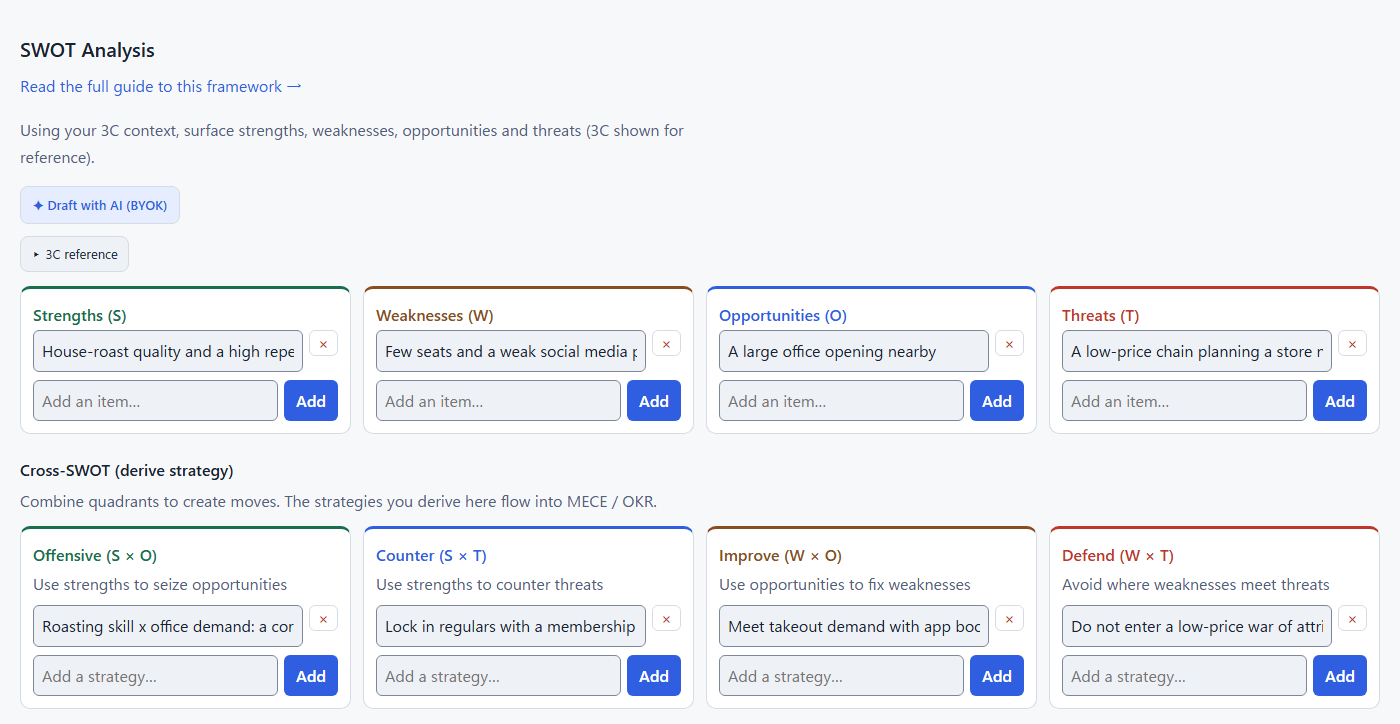
- Want to organize everything you found onto one page → SWOT analysis
- Want to derive concrete moves from strengths/weaknesses × opportunities/threats → Cross-SWOT (TOWS matrix)
- Want to choose a growth direction (which product × market to pursue) → Ansoff Matrix
- Want the big picture of how every framework connects → Strategy Frameworks Explained
- Want to decompose the issues with no gaps and no overlaps → MECE
- Want to make the decomposition visual → logic tree
Land it in execution and measurement
Once the strategy is set, turn it into targets you can actually execute.
- Want to know the difference between a monitoring metric and an ambitious target → KPI vs OKR
- Want to actually write measurable targets → How to write OKRs
- Want to turn the designed strategy into daily execution → Strategy execution (PDCA)
- Want to know how it applies to your own industry → Strategy frameworks by industry
- Want to know the limits of a framework too → The limits of SWOT analysis
Still stuck? Run this loop once
If you're still unsure, run through 3C → SWOT → Cross-SWOT (TOWS) → MECE → OKR once, in that order. 3C surveys the outside and inside, SWOT organizes it, Cross-SWOT derives moves, MECE decomposes and prioritizes them, and OKR lands them into measurable targets — that standard route alone covers most of the ground from reading the situation to executing on it. Slot in PEST, Five Forces, value chain, VRIO, STP, or Ansoff along the way when you need more precision.
This whole chain runs on one screen in this strategy cockpit. Everything you enter is stored only on your device (nothing is sent to our servers), and you can try the AI draft in SWOT for free with your own API key (BYOK; you cover only the API usage). A one-time $9.90 purchase unlocks the AI across all frameworks. Daily number tracking can be handed off to the sister app, Baton Board.
FAQ
Which framework should I use first?
When in doubt, start with 3C analysis. Seeing customer, competitor, and company at once tells you what to dig into next — PEST, Five Forces, or value chain. From there, move through SWOT → Cross-SWOT → MECE → OKR to cover the standard route.
There are too many analysis frameworks to choose from — what do I do?
Put "what I want to know right now" into a single sentence. The external environment maps to PEST, industry structure to Five Forces, your own activities to value chain, resource strength to VRIO, and narrowing your market to STP — the mapping is close to one-to-one. If you want to know several things, just work through several frameworks in turn.
Which framework is the best one, overall?
No single framework is a universal answer. Each looks from a different angle — external vs. internal, reading the situation vs. building strategy vs. executing — so using them together, by purpose, is the point. Combining them along this guide's three stages (analyze → strategize → execute and measure) looks like a longer path but is actually the fastest one.
Can I use more than one analysis framework at the "analyze" stage at once?
Yes. PEST, Five Forces, 3C, value chain, VRIO, and STP each look from a different angle — macro environment, industry structure, customer/competitor/company, your own activities, your own resources, and customer segments. Use as many as the situation calls for; you don't need to run all of them every time — pick by what you actually want to know right now.
What is a common mistake at the "execute and measure" stage?
Stopping once a strategy or target is set, without following through on daily number tracking (PDCA) or applying it to your specific industry. An OKR you never track again becomes a one-off fireworks show. Design here, then hand daily tracking off to a PDCA-style execution loop or a sister app like Baton Board to keep it running.
Other guides
- How to Do a SWOT Analysis — Complete Guide with Cross-SWOT (TOWS)
- How to Write OKRs — A Practical Guide with Examples
- How to Do a 3C Analysis — Customer, Competitor, Company
- What Is MECE? — Decompose Any Problem Without Gaps or Overlaps
- How to Use the TOWS Matrix (Cross-SWOT) — Turn Four Quadrants into Strategy
- Strategy Frameworks Explained — Use 3C, SWOT, TOWS, MECE and OKRs Together
- KPI vs OKR — the difference, when to use each, and how to connect them
- Turn Strategy into Execution — Running PDCA and Tracking the Daily Numbers (with Baton Board)
- Strategy Frameworks by Industry — 3C→SWOT→OKR Worked Examples for Four Business Types
- The Limits of SWOT Analysis — and How to Complement Them
- What Is PEST Analysis? Read the Macro-Environment and Feed SWOT
- What Is Porter's Five Forces? Read an Industry's Profit Structure
- What Is Value Chain Analysis? Break Down Internal Activities and Feed SWOT
- What Is the Ansoff Matrix? Choose a Growth Path by Product × Market and Feed OKR
- What Is a Logic Tree? — Break a Problem Down Branch by Branch (What/Why/How)
- What Is VRIO Analysis? Evaluate Internal Resources with Four Questions and Pick SWOT's Strengths
- What Is STP Marketing? Narrow the Market in Three Steps to Decide Who to Serve
- What Is the BCG Matrix (PPM)? Allocate Resources Across Businesses in Four Quadrants
- What Is Jobs to Be Done (JTBD)? Finding the "Job" Your Customer Needs Done
- Balanced Scorecard (BSC): four perspectives and a strategy map
- Business Model Canvas (BMC): nine building blocks on one page
Try it right in your browser (free, no signup)
Run 3C → SWOT → Cross-SWOT → MECE → OKR on one screen. Strategy data stays on your device; the SWOT AI draft is free (BYOK).
Open the app →