Strategy Frameworks by Industry — Worked Examples to Make It "Your Case"
Even after learning strategy frameworks, the last hurdle is "how do I actually use this in my industry?" In fact, only the contents of each box change by industry; the process (3C→SWOT→Cross-SWOT→MECE→OKR) is the same everywhere. This guide shows end-to-end examples for four representative business types, then how to adapt them to your own.
Only the contents change by industry — the order is the same
In any industry you first gather inputs with 3C (Customer, Competitor, Company), organize them into internal/external with SWOT, derive strategy with Cross-SWOT (TOWS), decompose the actions with MECE, and land measurable targets with OKR. The order is shared; what differs by industry is the content — who the customer is, what the strength is.
That is why reading other industries' examples gives you hints for filling in your own. Below are four end-to-end cases compressed to a line each (S×O = strengths for opportunities, W×O = opportunities to shore up weaknesses, S×T = strengths against threats, W×T = avoid where weakness meets threat).
Four worked examples (3C → strategy → OKR)
Each is written as "3C highlights → the strategy derived by crossing quadrants → one example OKR."
- Online language school: 3C = working-adult learners / big apps / instructor quality. S×O "instructor quality × remote-learning demand → launch a corporate-training plan." OKR "sign 5 corporate clients this quarter."
- Agency / BtoB studio: 3C = small businesses / freelance rivals / a portfolio of work. W×O "weak sales × digitalization demand → attract inbound with case-study articles." OKR "reach 10 inquiries per month."
- D2C / e-commerce: 3C = discerning buyers / big marketplaces / product story. S×T "brand strength × price competition → lock in regulars with a subscription." OKR "get subscription share to 30%."
- Freelancer (creative or specialist): 3C = the buyer contact / production companies / agility and rate negotiation. W×T "rates × pressure to underbid → do not enter low-rate attrition work." OKR "raise the average rate by 20%."
The point is you do not need to use all four quadrants. Per industry, pick the one or two directions that work, and use W×T to decide what NOT to do so resources concentrate.
Three steps to adapt it to your industry
Making an example your own is easy. Start writing with these three steps.
- Step 1: write 3C one line each. Customer = who struggles with what and pays for what; Competitor = who you are compared to and what they are good at; Company = what you have and what you lack.
- Step 2: sort the 3C content into internal/external. What you can change = strengths/weaknesses; what you cannot = opportunities/threats.
- Step 3: cross them to pick one or two strategies, decompose with MECE, and put a KPI/OKR number on each action.
How to choose industry-specific metrics (KPIs)
What number goes into an OKR Key Result comes from your industry's "profit structure." For food service, average check, table turnover, repeat rate; for SaaS, churn and LTV; for e-commerce, subscription share and cart abandonment; for professional services, average rate and utilization.
When unsure, decompose "revenue = what × what" and make each factor a candidate metric. Even an industry-specific metric follows the same discipline: land it as an Objective (qualitative, ambitious) and Key Results (quantitative, measurable).
Load an example and try it first
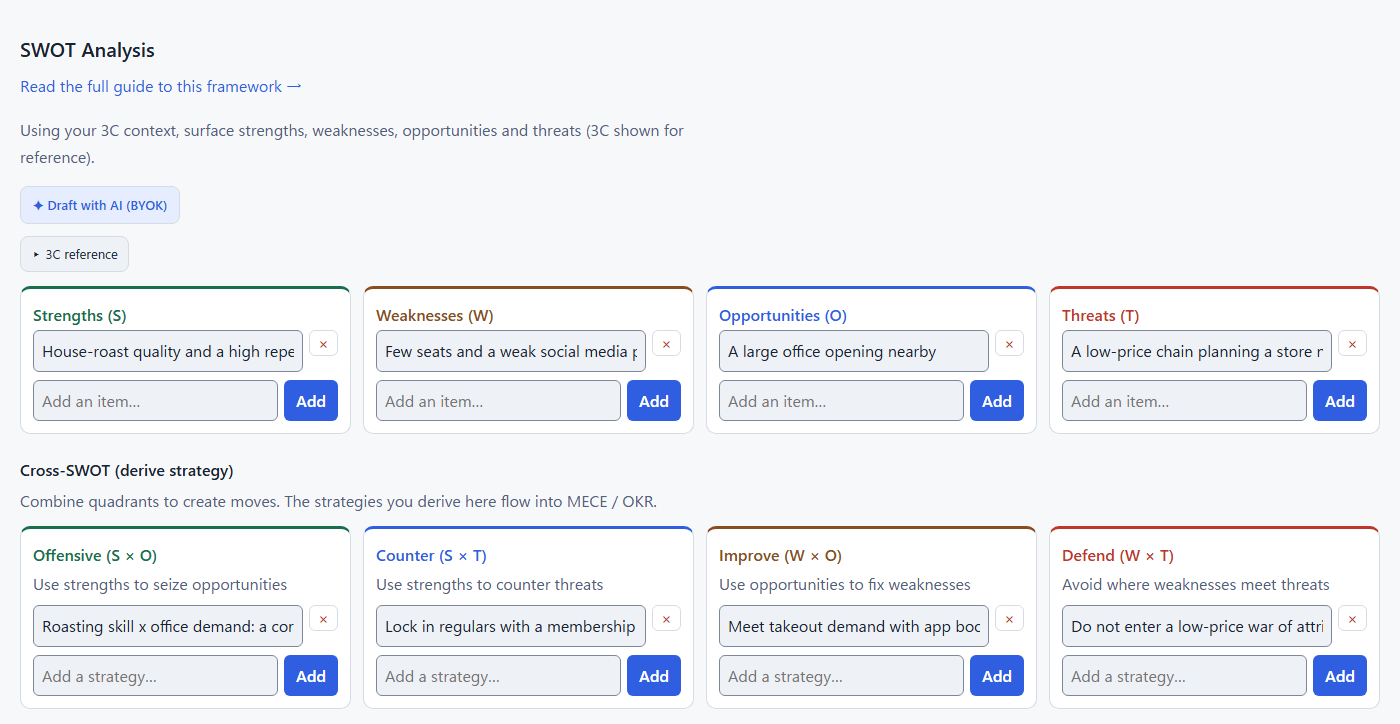
This strategy cockpit ships with samples for three business types for first-time users: a language school, a cafe, and a freelancer. Load the closest one and you can edit a finished 3C-to-OKR into your own.
This 3C→SWOT→Cross-SWOT→MECE→OKR chains on one screen, and everything you enter is stored only on your device (nothing is sent to our servers). You can try the AI draft in SWOT for free with your own API key (BYOK; you cover only the API usage). A one-time $9.90 purchase unlocks the AI across all frameworks.
FAQ
Does this framework work for any industry?
Yes. 3C→SWOT→Cross-SWOT→MECE→OKR is an industry-agnostic procedure; only the contents of each box change. It works for BtoB, BtoC, manufacturing, services, and solo businesses alike.
Where do industry-specific metrics (KPIs) go?
In the OKR Key Results. Decompose your industry's "profit structure" (revenue = what × what) and turn each factor into a measurable metric — average check and turnover for food service, churn for SaaS, subscription share for e-commerce, and so on.
Is it useful even for a one-person business?
Yes. The fewer your resources, the more valuable it is to decide what NOT to do (W×T), and tracking just one or two metrics reduces hesitation. The freelancer example above applies directly.
What is common across the four industry examples?
You don't need to use all four quadrants. For each industry, pick the one or two directions that actually pay off. W×T in particular — avoiding where a weakness and a threat overlap — decides what not to do, which concentrates your limited resources.
What are the steps to apply this to my own industry?
Step 1: write 3C one line at a time (Customer, Competitor, Company). Step 2: sort the findings into internal and external — what you can change becomes strengths/weaknesses, what you can't becomes opportunities/threats. Step 3: multiply them to pick one or two strategies, decompose with MECE, and put a KPI/OKR number on each move.
Other guides
- How to Do a SWOT Analysis — Complete Guide with Cross-SWOT (TOWS)
- How to Write OKRs — A Practical Guide with Examples
- How to Do a 3C Analysis — Customer, Competitor, Company
- What Is MECE? — Decompose Any Problem Without Gaps or Overlaps
- How to Use the TOWS Matrix (Cross-SWOT) — Turn Four Quadrants into Strategy
- Strategy Frameworks Explained — Use 3C, SWOT, TOWS, MECE and OKRs Together
- KPI vs OKR — the difference, when to use each, and how to connect them
- Turn Strategy into Execution — Running PDCA and Tracking the Daily Numbers (with Baton Board)
- The Limits of SWOT Analysis — and How to Complement Them
- What Is PEST Analysis? Read the Macro-Environment and Feed SWOT
- What Is Porter's Five Forces? Read an Industry's Profit Structure
- What Is Value Chain Analysis? Break Down Internal Activities and Feed SWOT
- What Is the Ansoff Matrix? Choose a Growth Path by Product × Market and Feed OKR
- What Is a Logic Tree? — Break a Problem Down Branch by Branch (What/Why/How)
- What Is VRIO Analysis? Evaluate Internal Resources with Four Questions and Pick SWOT's Strengths
- What Is STP Marketing? Narrow the Market in Three Steps to Decide Who to Serve
- How to Choose a Strategy Framework — Which One, and When
- What Is the BCG Matrix (PPM)? Allocate Resources Across Businesses in Four Quadrants
- What Is Jobs to Be Done (JTBD)? Finding the "Job" Your Customer Needs Done
- Balanced Scorecard (BSC): four perspectives and a strategy map
- Business Model Canvas (BMC): nine building blocks on one page
Load a sample and try it (free, no signup)
Load a language-school, cafe, or freelancer sample in one click. 3C→SWOT→Cross-SWOT→MECE→OKR on one screen; strategy data stays on your device; the SWOT AI draft is free (BYOK).
Open the app →