What Is Jobs to Be Done (JTBD)? Finding the Job Your Customer Needs Done
Jobs to Be Done (JTBD) holds that customers don't simply "buy" a product or service — they "hire" it to get a "job" done. Instead of grouping customers by attributes like age or gender, JTBD reads them by the situation they're in and what they're trying to accomplish. It is credited to management scholar Clayton Christensen, who popularized it in his book Competing Against Luck (and the well-known milkshake example). This guide explains the three types of jobs and how JTBD differs from STP and SWOT, with a café example.
What Jobs to Be Done is — customers hire products to get a job done
The core of JTBD is that customers don't buy a product — they hire it to get a job done that needs doing. The same product can serve a different job depending on the customer's situation. Rather than grouping customers by attributes (age, gender, income), JTBD asks "what situation are they in, and what are they trying to accomplish?"
That shift in perspective surfaces competitors you might otherwise miss. If the job is "focus quietly on my work," the competition isn't just other cafés — it can be a library, a coworking space, or a home desk.
Three types of jobs (a café example)
The same café customer can be hiring a different job depending on the situation.
- Functional job: getting a concrete task or problem done. E.g., grabbing something fast with caffeine before a morning commute.
- Emotional job: something to satisfy emotionally. E.g., feeling calm and settled in a quiet space while focusing on work.
- Social job: how the customer wants to be seen or connect with others. E.g., having a comfortable, easy-to-talk-in social space when meeting a friend.
The decision flow: feeding JTBD into STP and SWOT
The job you uncover becomes material for STP. Customers sharing the same job form a segment (Segmentation); which job you answer decides who you pursue (Targeting); becoming the entity best able to get that job done defines your position (Positioning) — JTBD finds the job first, and STP turns it into market strategy.
If many customers are getting a job done poorly, that becomes material for SWOT's "opportunities." Conversely, if your company can get a specific job done better than anyone else, that becomes material for SWOT's "strengths."
How it differs from 3C and STP — discovering the job vs. market strategy
JTBD, 3C analysis, and STP all look at the "customer," but their roles differ. 3C surveys the whole market through customer, competitor, and company; STP splits the market to choose a target and a position. JTBD digs one level deeper still: what job does this customer actually need done?
The natural order is: discover the job with JTBD, then use STP to set the segment, target, and position around that job. This adds situation-based customer understanding that attribute-based segmentation alone can't surface.
A caveat with Jobs to Be Done, and on to SWOT → Cross-SWOT → MECE → OKR
Jobs to Be Done has a caveat. Identifying a "job" involves interpretation, and defining the situation too broadly tends to make the job vague. That is why it matters to back it with real data — customer interviews and the like — and verify it against SWOT analysis and measurable OKR targets.
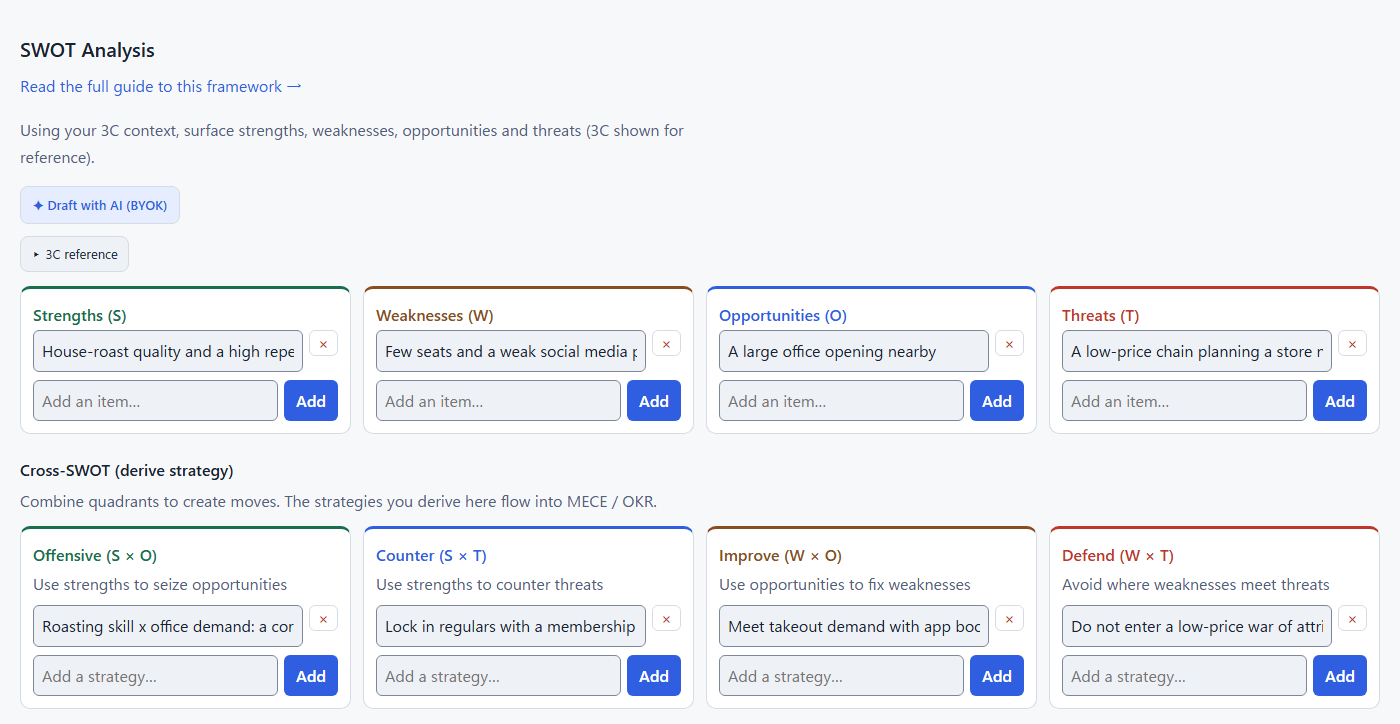
Connect the job you found with JTBD into SWOT → Cross-SWOT (TOWS) → MECE → OKR and land it into measurable targets. This whole chain runs on one screen in this strategy cockpit. Everything you enter is stored only on your device (nothing is sent to our servers), and you can try the AI draft in SWOT for free with your own API key (BYOK; you cover only the API usage). A one-time $9.90 purchase unlocks the AI across all frameworks. Daily number tracking can be handed off to the sister app, Baton Board.
FAQ
What are the three types of jobs in Jobs to Be Done?
Functional (getting a concrete task or problem done), emotional (something to satisfy emotionally), and social (how the customer wants to be seen by others). The same customer can prioritize a different job depending on the situation.
How do I choose between Jobs to Be Done and STP analysis?
JTBD discovers the "job" your customer actually needs done; STP segments the market around that job and chooses a target and a position. A good order is to find the job with JTBD first, then turn it into market strategy with STP.
What is the weakness of Jobs to Be Done?
Identifying a "job" involves interpretation, and defining the situation too broadly tends to make it vague. It is not a method that reaches a single right answer on its own — it assumes you back it with real data, like customer interviews, and verify it against SWOT analysis and measurable OKR targets.
Can you give a concrete example of Jobs to Be Done (a café example)?
The same café customer hires a different job depending on the situation. Before a morning commute, it's a functional job (getting something fast with caffeine). While wanting to focus, it's an emotional job (feeling calm and settled in a quiet space). When meeting a friend, it's a social job (having a comfortable, easy-to-talk-in social space).
What book popularized Jobs to Be Done?
It is credited to management scholar Clayton Christensen, who popularized it in his book Competing Against Luck (and the well-known milkshake example).
Other guides
- How to Do a SWOT Analysis — Complete Guide with Cross-SWOT (TOWS)
- How to Write OKRs — A Practical Guide with Examples
- How to Do a 3C Analysis — Customer, Competitor, Company
- What Is MECE? — Decompose Any Problem Without Gaps or Overlaps
- How to Use the TOWS Matrix (Cross-SWOT) — Turn Four Quadrants into Strategy
- Strategy Frameworks Explained — Use 3C, SWOT, TOWS, MECE and OKRs Together
- KPI vs OKR — the difference, when to use each, and how to connect them
- Turn Strategy into Execution — Running PDCA and Tracking the Daily Numbers (with Baton Board)
- Strategy Frameworks by Industry — 3C→SWOT→OKR Worked Examples for Four Business Types
- The Limits of SWOT Analysis — and How to Complement Them
- What Is PEST Analysis? Read the Macro-Environment and Feed SWOT
- What Is Porter's Five Forces? Read an Industry's Profit Structure
- What Is Value Chain Analysis? Break Down Internal Activities and Feed SWOT
- What Is the Ansoff Matrix? Choose a Growth Path by Product × Market and Feed OKR
- What Is a Logic Tree? — Break a Problem Down Branch by Branch (What/Why/How)
- What Is VRIO Analysis? Evaluate Internal Resources with Four Questions and Pick SWOT's Strengths
- What Is STP Marketing? Narrow the Market in Three Steps to Decide Who to Serve
- How to Choose a Strategy Framework — Which One, and When
- What Is the BCG Matrix (PPM)? Allocate Resources Across Businesses in Four Quadrants
- Balanced Scorecard (BSC): four perspectives and a strategy map
- Business Model Canvas (BMC): nine building blocks on one page
Try it right in your browser (free, no signup)
Find the job your customer needs done with JTBD, then move to SWOT → Cross-SWOT → MECE → OKR. One screen; strategy data stays on your device; the SWOT AI draft is free (BYOK).
Open the app →