What Is PEST Analysis? Connecting the Macro-Environment to SWOT
PEST analysis reads the wider environment around your business through four lenses: Politics, Economy, Society, and Technology. Its origin is widely attributed to Francis Aguilar, who in his 1967 book "Scanning the Business Environment" set out a framework for scanning the environment (originally as ETPS). Mapping the external forces you cannot change first lets you write evidence-based items into SWOT's opportunities and threats. This guide explains each factor, how it differs from 3C, and how to connect it to SWOT, using a café example.
What PEST analysis is — reading the macro-environment from four angles
PEST stands for Politics (and regulation), Economy, Society (and culture), and Technology. All are "external environment" that no single company can move, and each can be a tailwind or a headwind for your business.
The point of doing PEST first is to avoid building strategy on assumptions. Taking stock of change from four directions surfaces opportunities you missed and threats quietly approaching. There is an extended version, PESTLE / PESTEL, that adds Legal and Environmental, but the four factors are plenty to start with.
P, E, S, T: what each one covers (a café example)
Take a small café near a station and list what is "changing" under each factor.
- P (Politics / regulation): food-business permits, changes to passive-smoking law, minimum-wage rises, invoicing rules. When rules change, cost and operations change.
- E (Economy): inflation and input costs, interest rates, local foot traffic and disposable income. The economy directly hits average spend and visit frequency.
- S (Society / culture): remote work reshaping demand in office districts, health consciousness, "Instagrammable" demand on social media — shifts in people's values and behavior.
- T (Technology): mobile payments, mobile ordering, delivery apps, social-media marketing tools. Use them and they become strengths; ignore them and you fall behind.
Feeding PEST into SWOT's opportunities and threats
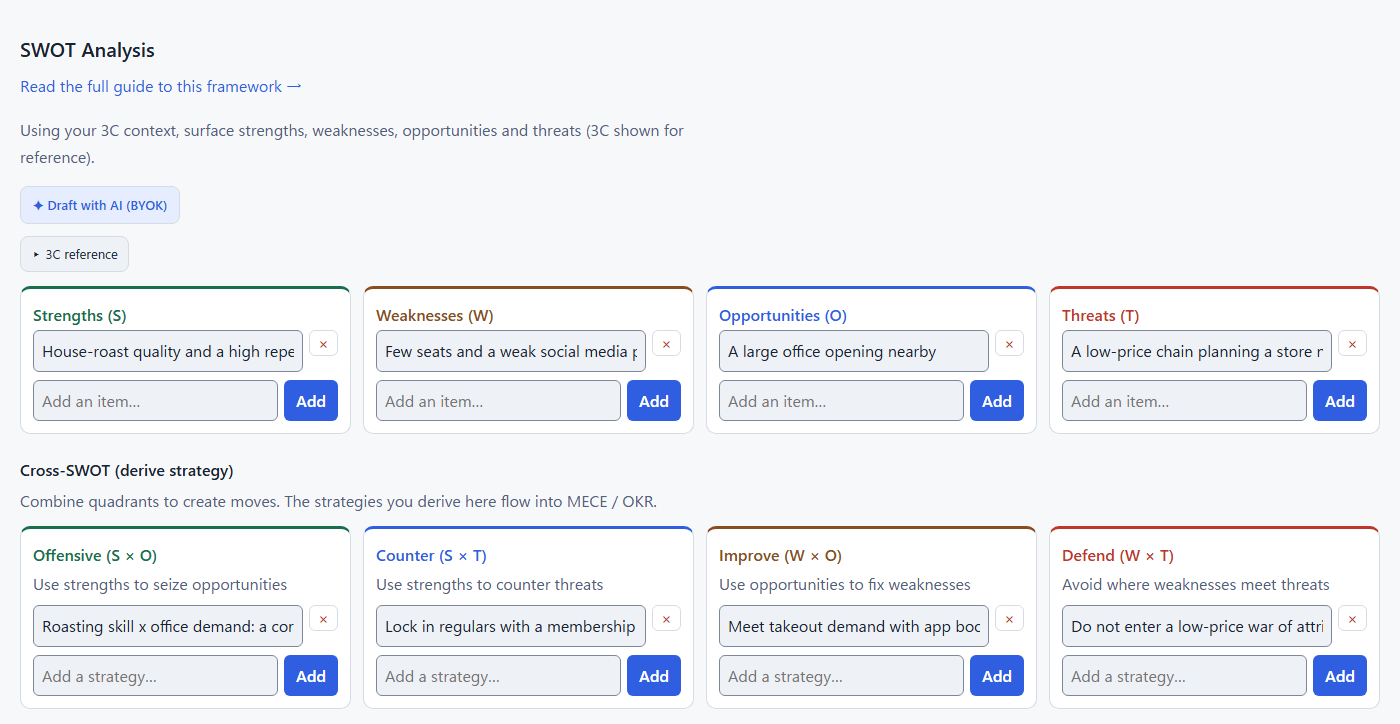
Each PEST item becomes raw material for the external factors of SWOT (Opportunity and Threat). For example, "more remote workers nearby (S)" is an opportunity — weekday daytime demand for longer stays. "A minimum-wage rise (P)" or "surging input costs (E)" are threats.
The key is not to confuse them with internal factors (strengths and weaknesses). External change you cannot control goes into PEST = SWOT's opportunities/threats; your own resources (roasting skill, regulars, location) go into strengths/weaknesses. That split prevents the classic SWOT mistake of mixing internal and external.
How it differs from 3C — use both macro (PEST) and micro (3C)
PEST and 3C analysis both look outward, but from different heights. PEST reads the "society-wide macro backdrop" — politics, economy and so on; 3C reads the "micro structure of your industry and market" — Customer, Competitor, Company.
The recommendation is to use both. Capture the big tectonic shifts with PEST, then pin down the specifics of your market with 3C. Funnel both into SWOT's opportunities and threats and your external analysis has fewer gaps. A natural order is "PEST (macro) → 3C (micro) → SWOT."
Run PEST → SWOT → Cross-SWOT → MECE → OKR
Stopping at PEST alone tends to leave you having "only looked at the environment." Connect the inputs to strategy and action. Gather external inputs with PEST (+ 3C) → organize with SWOT → derive "what to do in this environment" with Cross-SWOT (TOWS) → decompose the issues and prioritize with MECE → land them into measurable OKR targets. That chain turns environmental awareness into concrete moves.
This PEST → SWOT → Cross-SWOT → MECE → OKR runs on one screen in this strategy cockpit. Everything you enter is stored only on your device (nothing is sent to our servers), and you can try the AI draft in SWOT for free with your own API key (BYOK; you cover only the API usage). A one-time $9.90 purchase unlocks the AI across all frameworks. Daily number tracking can be handed off to the sister app, Baton Board.
FAQ
What is the difference between PEST and PESTLE (PESTEL)?
PEST has four factors — Political, Economic, Social, Technological. PESTLE/PESTEL is the extended version that adds Legal and Environmental. In sectors heavily affected by regulation or environmental issues, PESTLE fits better, but starting with the four-factor PEST is plenty.
How do I choose between PEST and 3C analysis?
PEST reads the society-wide macro backdrop (politics, economy and so on); 3C reads the micro structure of your market (Customer, Competitor, Company). Use both, funneling the external picture in the order "PEST (macro) → 3C (micro) → SWOT."
How often should I run a PEST analysis?
The macro-environment changes slowly, so a quarterly-to-yearly review is a good rhythm. Still, update it whenever something that hits your business appears — a legal change, a big economic swing, a new technology. Running it alongside your SWOT and OKR reviews keeps it natural.
Can you give concrete examples for each PEST element?
Politics — business permits, smoking-law changes, minimum wage hikes. Economy — rising prices, interest rates, disposable income. Society — remote work becoming the norm, health-consciousness, shifting social-media demand. Technology — mobile payments, mobile ordering, delivery apps. Use them and they become a strength; ignore them and you fall behind.
Where does PEST analysis come from?
It is widely credited to Francis Aguilar, who set out an environmental-scanning framework (originally called ETPS) in his 1967 book Scanning the Business Environment.
Other guides
- How to Do a SWOT Analysis — Complete Guide with Cross-SWOT (TOWS)
- How to Write OKRs — A Practical Guide with Examples
- How to Do a 3C Analysis — Customer, Competitor, Company
- What Is MECE? — Decompose Any Problem Without Gaps or Overlaps
- How to Use the TOWS Matrix (Cross-SWOT) — Turn Four Quadrants into Strategy
- Strategy Frameworks Explained — Use 3C, SWOT, TOWS, MECE and OKRs Together
- KPI vs OKR — the difference, when to use each, and how to connect them
- Turn Strategy into Execution — Running PDCA and Tracking the Daily Numbers (with Baton Board)
- Strategy Frameworks by Industry — 3C→SWOT→OKR Worked Examples for Four Business Types
- The Limits of SWOT Analysis — and How to Complement Them
- What Is Porter's Five Forces? Read an Industry's Profit Structure
- What Is Value Chain Analysis? Break Down Internal Activities and Feed SWOT
- What Is the Ansoff Matrix? Choose a Growth Path by Product × Market and Feed OKR
- What Is a Logic Tree? — Break a Problem Down Branch by Branch (What/Why/How)
- What Is VRIO Analysis? Evaluate Internal Resources with Four Questions and Pick SWOT's Strengths
- What Is STP Marketing? Narrow the Market in Three Steps to Decide Who to Serve
- How to Choose a Strategy Framework — Which One, and When
- What Is the BCG Matrix (PPM)? Allocate Resources Across Businesses in Four Quadrants
- What Is Jobs to Be Done (JTBD)? Finding the "Job" Your Customer Needs Done
- Balanced Scorecard (BSC): four perspectives and a strategy map
- Business Model Canvas (BMC): nine building blocks on one page
Try it right in your browser (free, no signup)
Read the outside with PEST (macro), then move to SWOT → Cross-SWOT → MECE → OKR. One screen; strategy data stays on your device; the SWOT AI draft is free (BYOK).
Open the app →