Business strategy frameworks were never meant to be isolated tools. Read your environment with 3C, sort it into strengths, weaknesses, opportunities and threats with SWOT, derive concrete strategies with Cross-SWOT (TOWS), break them down into mutually exclusive, collectively exhaustive pieces with MECE, and land them as measurable goals with KPI/OKR — Norolu Frameworks chains this whole cascade in a single screen. The output of each step becomes the input of the next. And everything you type is stored on your device only; nothing is ever sent to our servers (zero-trust design).
Four frameworks, one connected flow
No more hopping between single-purpose tools. Five stages are linked so each result feeds the next.
- 013C analysis (Customer / Competitor / Company): Map the market and your own position to find where you can win. What you write here becomes the foundation of your SWOT.
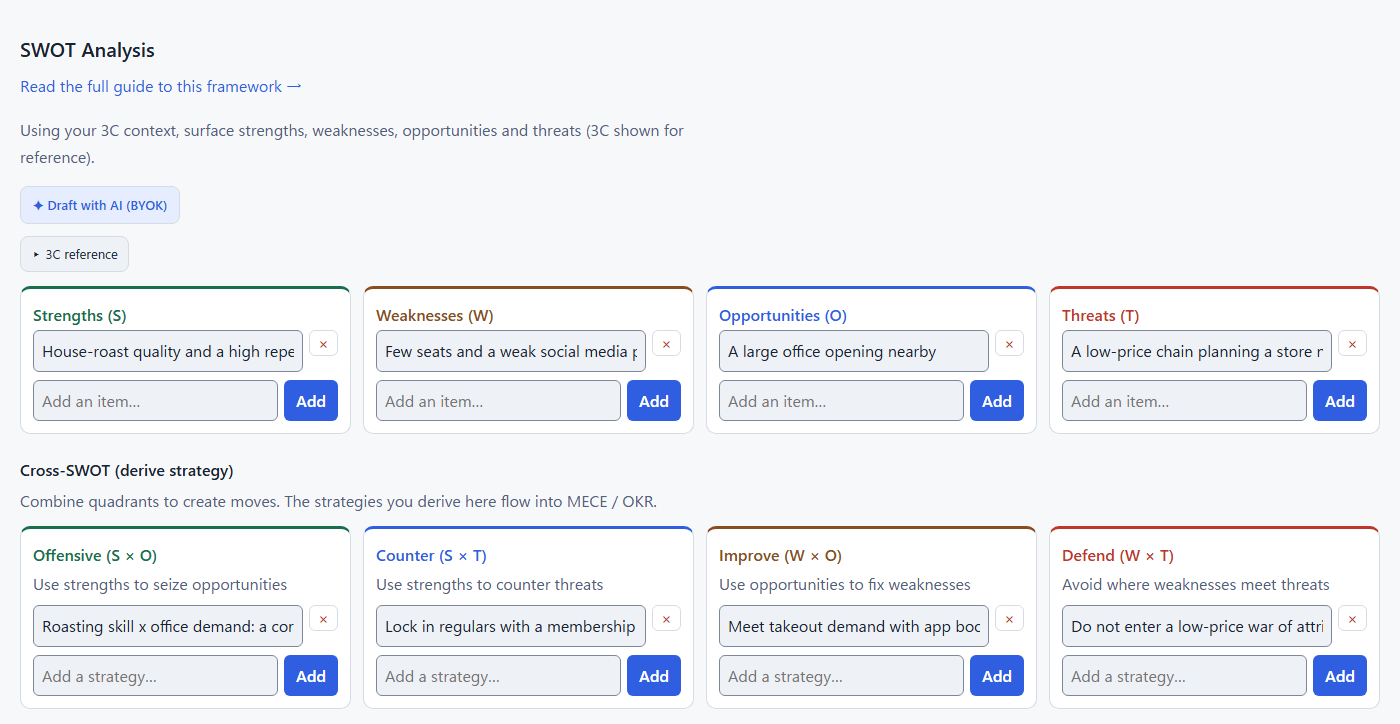
- 02SWOT analysis (Strengths / Weaknesses / Opportunities / Threats): List internal strengths and weaknesses, and external opportunities and threats — with your 3C notes shown for reference. You stay the judge.
- 03Cross-SWOT (TOWS / strategy derivation): Combine the quadrants to derive strategies: leverage (S×O), counter (S×T), improve (W×O) and defend (W×T). Abstract analysis turns into concrete moves.
- 04MECE decomposition: Break the derived strategies into an issue tree with no gaps and no overlaps. Duplicate warnings on the same level help keep it mutually exclusive.
- 05KPI / OKR (make it measurable): Turn issues into a qualitative, ambitious Objective and measurable Key Results. Day-to-day tracking can hand off to the sister app Baton Board.
Two surfaces: Web and MCP
Work with the same strategy data from two entrances.
- Web (PWA): Runs in your browser instantly and works offline once installed. No account required.
- MCP server (AI agent integration): AI agents such as Claude can write 3C, SWOT, MECE and OKR directly into your local data. AI drafts, you decide.
Let AI agents fill your strategy canvas (MCP)
AI agents such as Claude write 3C, SWOT, MECE and OKR straight into your local data.json through the official MCP (Model Context Protocol) server. The AI drafts the strategy; you decide what to keep. Load the exported JSON with "Restore" in the web app and the strategy the AI filled in appears on screen. Only local files are exchanged — nothing goes over the network (zero-trust).
Published for AI agents: npm · norolu-frameworks-mcp · MCP Registry · Works with Claude
Just add this to the MCP settings of Claude Desktop or Code (npx fetches it from npm and launches it — no install):
{
  "mcpServers": {
    "norolu-frameworks": {
      "command": "npx",
      "args": ["-y", "norolu-frameworks-mcp"],
      "env": { "FRAMEWORKS_DATA": "/path/to/frameworks-data.json" }
    }
  }
}
Point FRAMEWORKS_DATA at the JSON file where you want the strategy saved. Tools include set_3c, add_swot, set_mece and define_okr. Full setup is on the npm package page linked above.
Example: ask an AI agent (Claude, etc.) for a strategy, and it calls the MCP tools to fill the canvas like this:
# "Draft a strategy for a small cafe."
set_3c      → customer / competitor / company
add_swot    → strengths: house-roast quality, loyal regulars
add_swot    → threats: a low-price chain opening nearby
set_mece    → "How do we grow sales?" → customer count / spend per visit
define_okr  → "Lift weekday lunch sales 1.5x in 3 months" + key results
# → your local data.json now holds a full 3C → SWOT → MECE → OKR strategy
AI assistant (BYOK) — try it free on SWOT
Draft candidates with AI in every framework using your own API key (Anthropic or OpenAI). Requests go straight from your browser to the provider — never through our servers. SWOT is free to try; a one-time $9.90 purchase unlocks AI in all frameworks. No subscription.
Privacy: your strategy data stays on your device (zero-trust)
Everything you enter is stored only on your device (browser local storage or a local file). We do not send it to our servers or load external CDN fonts; we use only privacy-friendly, cookieless aggregate analytics (no cookies, no cross-site tracking, no ads). Export to Markdown or PNG anytime. This tool supports your thinking; it does not guarantee the accuracy or outcome of any suggestion — final decisions are yours.
Who it is for
Founders and executives building a strategy from scratch, product managers structuring business plans and pitch decks, consultants and students who want to use frameworks properly, and everyone who wants to run strategy together with AI. Available in Japanese, English, Chinese, Korean, Spanish, Portuguese, French and German.
- 📖 How to Do a SWOT Analysis — Complete Guide with Cross-SWOT (TOWS)
- 📖 How to Write OKRs — A Practical Guide with Examples
- 📖 How to Do a 3C Analysis — Customer, Competitor, Company
- 📖 What Is MECE? — Decompose Any Problem Without Gaps or Overlaps
- 📖 How to Use the TOWS Matrix (Cross-SWOT) — Turn Four Quadrants into Strategy
- 📖 Strategy Frameworks Explained — Use 3C, SWOT, TOWS, MECE and OKRs Together
- 📖 KPI vs OKR — the difference, when to use each, and how to connect them
- 📖 Turn Strategy into Execution — Running PDCA and Tracking the Daily Numbers (with Baton Board)
- 📖 Strategy Frameworks by Industry — 3C→SWOT→OKR Worked Examples for Four Business Types
- 📖 The Limits of SWOT Analysis — and How to Complement Them
- 📖 What Is PEST Analysis? Read the Macro-Environment and Feed SWOT
- 📖 What Is Porter's Five Forces? Read an Industry's Profit Structure
- 📖 What Is Value Chain Analysis? Break Down Internal Activities and Feed SWOT
- 📖 What Is the Ansoff Matrix? Choose a Growth Path by Product × Market and Feed OKR
- 📖 What Is a Logic Tree? — Break a Problem Down Branch by Branch (What/Why/How)
- 📖 What Is VRIO Analysis? Evaluate Internal Resources with Four Questions and Pick SWOT's Strengths
- 📖 What Is STP Marketing? Narrow the Market in Three Steps to Decide Who to Serve
- 📖 How to Choose a Strategy Framework — Which One, and When
- 📖 What Is the BCG Matrix (PPM)? Allocate Resources Across Businesses in Four Quadrants
- 📖 What Is Jobs to Be Done (JTBD)? Finding the "Job" Your Customer Needs Done
- 📖 Balanced Scorecard (BSC): four perspectives and a strategy map
- 📖 Business Model Canvas (BMC): nine building blocks on one page