What Is Value Chain Analysis? Connecting Internal Activities to SWOT
Value chain analysis is an internal-analysis framework that breaks your business into "a chain of activities that create value" and reads where value is created and where cost, strengths, and weaknesses lie. Michael Porter set it out in his 1985 book "Competitive Advantage." It splits activities into "primary activities" — the flow that makes and delivers the product — and "support activities" that underpin them. Breaking the inside down first lets you write evidence-based items into SWOT's strengths and weaknesses. This guide explains each activity, how it differs from PEST and Five Forces, and how to connect it to SWOT, using a café example.
What value chain analysis is — breaking down the activities that create value
The value chain views the activities from sourcing materials to reaching the customer as links in a chain, and looks at the "value each activity creates" and the "cost it incurs." The gap where value exceeds cost is the "margin" — the source of profit.
Porter split activities into two kinds. (1) Primary activities — inbound logistics, operations, outbound logistics, marketing & sales, service (the flow that makes and delivers the product itself); (2) Support activities — firm infrastructure, human resource management, technology development, procurement (which underpin the primary ones). Seeing which activity sets you apart makes your strengths and weaknesses concrete.
Primary and support activities: what each covers (a café example)
Take a small café near a station and walk the "primary activities" in chain order.
- Inbound logistics (sourcing): procuring beans, milk, and supplies, and their quality. Being able to source good beans reliably is the starting point.
- Operations: roasting, brewing, and prep skill. This craft decides the taste — often the center of differentiation.
- Outbound logistics (serving): in-store flow, takeout handoff, speed of service.
- Marketing & sales: social posting, building regulars, signage and location appeal.
- Service: hospitality and community-building — the key to repeat visits.
Support activities, and feeding the value chain into SWOT's strengths and weaknesses
Support activities underpin the primary ones: firm infrastructure (store management, finance), human resource management (hiring and training baristas), technology development (mobile ordering, POS), and procurement (the mechanism for supplier negotiation). They are less visible, but how well they run shapes the quality of the primary activities.
Rate each activity as "strong or weak versus competitors" and it becomes the internal factor of SWOT directly. Strong activities (e.g., self-roasting skill, a regulars community) = strengths; weak ones (e.g., high input cost, slow service) = weaknesses. The value chain's advantage is that it surfaces strengths and weaknesses activity by activity, not as hunches.
How it differs from 3C, PEST, and Five Forces — use internal (VC) and external (the rest) as two wheels
The big difference is "looking inward vs. outward." The value chain breaks down "the internal" — your own activities — and feeds SWOT's strengths and weaknesses (S/W). By contrast, 3C (players), Five Forces (industry structure), and PEST (macro) look at "the external" and feed opportunities and threats (O/T).
The recommendation is to use both wheels. Surface opportunities and threats with the external set (PEST/Five Forces/3C), and strengths and weaknesses with the internal one (value chain). Funnel both into SWOT for a balanced, inside-and-outside read of where you stand. This division of labor also prevents SWOT's classic "internal/external mix-up."
Run Value Chain → SWOT → Cross-SWOT → MECE → OKR
Stopping at the value chain alone tends to leave you having "only listed activities." Connect the inputs to strategy and action. Surface internal strengths and weaknesses with the value chain (+ external via PEST/Five Forces/3C) → organize with SWOT → derive "where to apply your strengths" with Cross-SWOT (TOWS) → decompose the issues and prioritize with MECE → land them into measurable OKR targets. That chain turns the breakdown of activities into concrete moves.
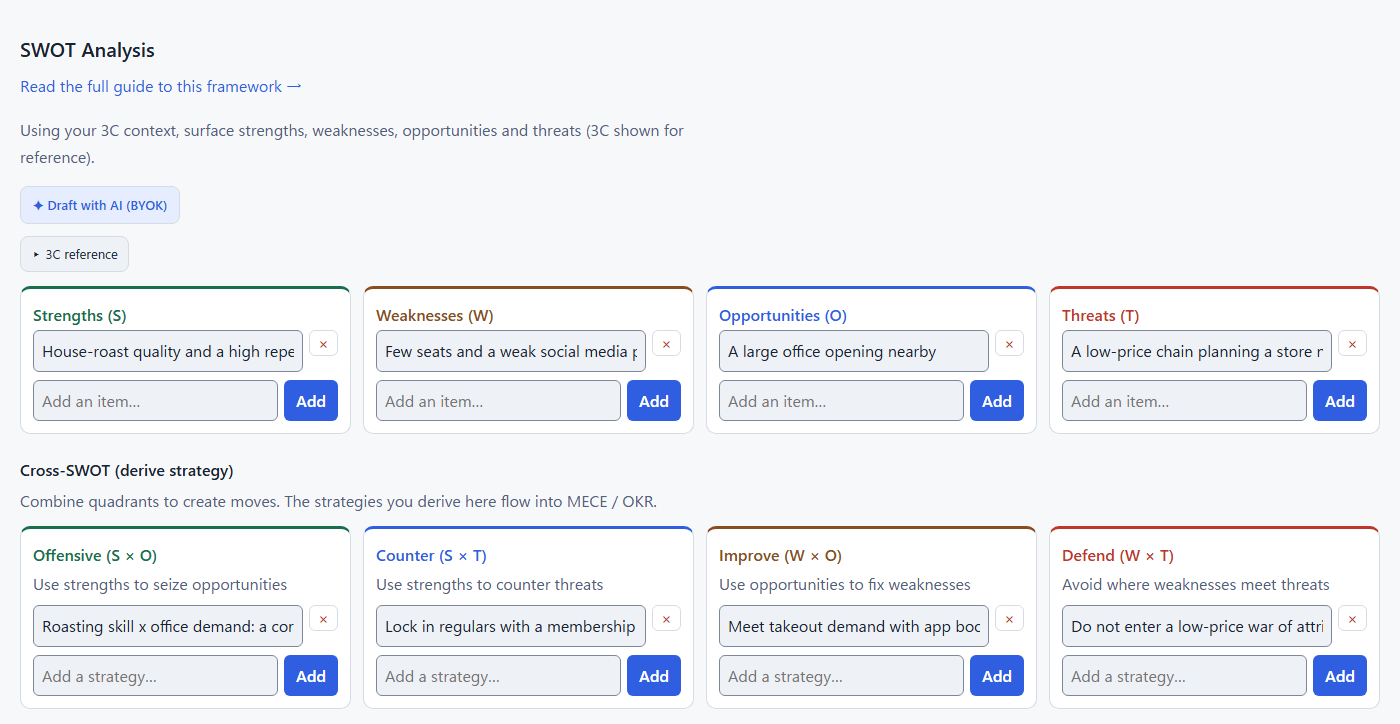
This Value Chain → SWOT → Cross-SWOT → MECE → OKR runs on one screen in this strategy cockpit. Everything you enter is stored only on your device (nothing is sent to our servers), and you can try the AI draft in SWOT for free with your own API key (BYOK; you cover only the API usage). A one-time $9.90 purchase unlocks the AI across all frameworks. Daily number tracking can be handed off to the sister app, Baton Board.
FAQ
How do I choose between value chain, 3C, PEST, and Five Forces analysis?
The value chain breaks down "the internal" — your own activities — and feeds SWOT's strengths and weaknesses (S/W). 3C, Five Forces, and PEST look at "the external" and feed opportunities and threats (O/T). Split the labor — internal = value chain, external = the other three — and funnel both into SWOT.
What is the difference between primary and support activities?
Primary activities are inbound logistics, operations, outbound logistics, marketing & sales, and service — "the flow that makes and delivers the product to the customer." Support activities are firm infrastructure, human resource management, technology development, and procurement — which "underpin the primary ones." You look at both to diagnose where value and advantage come from.
What is the weakness of value chain analysis?
It is a point-in-time organization of internal activities and is not a move on its own. It also ignores the external environment (market, competitors, macro), so you need to combine it with external analysis (3C, Five Forces, PEST). That is why you convert it to strategy with SWOT and Cross-SWOT and land it into measurable OKR targets.
Who is credited with value chain analysis?
Michael Porter set it out in his 1985 book Competitive Advantage.
Can you give concrete examples of the activities (a café example)?
Primary activities — inbound logistics (sourcing beans and milk), operations (roasting, brewing), outbound logistics (in-store flow, service), marketing/sales (social media), service (hospitality, community). Support activities — firm infrastructure (store operations), HR management (hiring and training baristas), technology development (mobile ordering), procurement (sourcing negotiations).
Other guides
- How to Do a SWOT Analysis — Complete Guide with Cross-SWOT (TOWS)
- How to Write OKRs — A Practical Guide with Examples
- How to Do a 3C Analysis — Customer, Competitor, Company
- What Is MECE? — Decompose Any Problem Without Gaps or Overlaps
- How to Use the TOWS Matrix (Cross-SWOT) — Turn Four Quadrants into Strategy
- Strategy Frameworks Explained — Use 3C, SWOT, TOWS, MECE and OKRs Together
- KPI vs OKR — the difference, when to use each, and how to connect them
- Turn Strategy into Execution — Running PDCA and Tracking the Daily Numbers (with Baton Board)
- Strategy Frameworks by Industry — 3C→SWOT→OKR Worked Examples for Four Business Types
- The Limits of SWOT Analysis — and How to Complement Them
- What Is PEST Analysis? Read the Macro-Environment and Feed SWOT
- What Is Porter's Five Forces? Read an Industry's Profit Structure
- What Is the Ansoff Matrix? Choose a Growth Path by Product × Market and Feed OKR
- What Is a Logic Tree? — Break a Problem Down Branch by Branch (What/Why/How)
- What Is VRIO Analysis? Evaluate Internal Resources with Four Questions and Pick SWOT's Strengths
- What Is STP Marketing? Narrow the Market in Three Steps to Decide Who to Serve
- How to Choose a Strategy Framework — Which One, and When
- What Is the BCG Matrix (PPM)? Allocate Resources Across Businesses in Four Quadrants
- What Is Jobs to Be Done (JTBD)? Finding the "Job" Your Customer Needs Done
- Balanced Scorecard (BSC): four perspectives and a strategy map
- Business Model Canvas (BMC): nine building blocks on one page
Try it right in your browser (free, no signup)
Surface internal strengths and weaknesses with the value chain, then move to SWOT → Cross-SWOT → MECE → OKR. One screen; strategy data stays on your device; the SWOT AI draft is free (BYOK).
Open the app →