Turn Strategy into Execution — PDCA and Daily Tracking So Design Is Not the End
You can design a strategy with 3C→SWOT→Cross-SWOT→MECE→OKR and still stop right there. The reason is simple: designing and executing are entirely different jobs. Design is thinking you do once every few weeks; execution is running things every day and every week. This guide covers taking the strategy you designed, running it with PDCA (Plan-Do-Check-Act), and tracking your OKR Key Results as daily numbers.
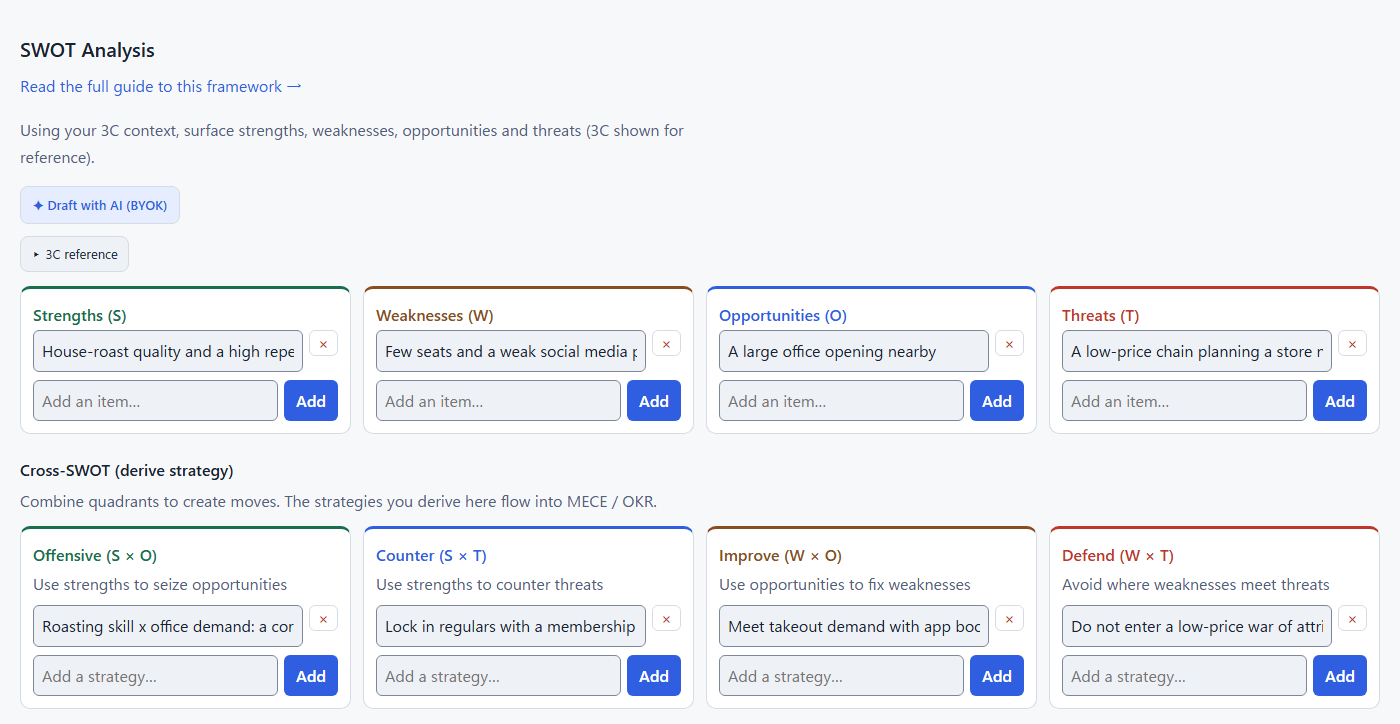
The "we made a strategy" trap
The pitfall of strategy frameworks is that filling the canvas creates a sense of completion, and work stops there. You wrote a SWOT, derived actions with TOWS, landed an OKR — but that is a blueprint, not the building.
Splitting design from execution clears it up. Design is the low-frequency decision of what to do and what not to do. Execution is the high-frequency work of advancing those decisions daily and correcting drift. Try to run both at the same rhythm and execution usually withers into a formality.
What PDCA is — four steps that keep improving
PDCA is an operating cycle that repeats Plan → Do → Check → Act. Walter Shewhart, of statistical quality control, proposed the original form and W. Edwards Deming popularized it (Deming himself later favored PDSA, replacing Check with Study).
The point is to not stop after one lap. Feed what you learned in Act back into the next Plan, tightening accuracy in a spiral. Think of strategy design as the first big Plan, then run small PDCA laps quickly after that.
- Plan: land your OKR Objective and Key Results into this period's plan
- Do: run the initiatives that move the Key Results
- Check: review regularly whether the Key Result numbers are moving as planned
- Act: if they drift, change the initiative or revise the target (into the next Plan)
Related explainer (external site): Why PDCA fails to turn, and how to fix it
Put the OKR you designed here into PDCA's Plan
The OKR you build in this strategy cockpit becomes your PDCA Plan directly. The Objective is where you are headed; the Key Results are the yardstick for Check. Holding Key Results with real numbers (e.g., pitch 10 companies in month one; keep cost ratio under 40%) lets Check judge "on track or not" by numbers, not by feel.
At the design stage, decompose the actions with MECE so nothing is missing, and place a measurable KR on each. If targets are vague once you enter execution, Check ends as a vague "seems fine."
Related explainer (external site): Connect team goals to individual action
Hand off Check (daily number tracking) to Baton Board
The design/execution split becomes a tool split. Designing the strategy — assembling 3C through OKR — is this site's job. Tracking the KPIs/OKRs you designed as daily numbers over time and watching the trend is the job of the sister app, Baton Board.
Design here, track day to day in Baton Board. With that division the design tool does not get cluttered with daily data, and the execution tool does not carry the weight of design. Noticing an anomaly in Check and returning to design in Act then loops naturally.
The whole picture, design to execution
In short: read the environment with 3C, organize with SWOT, derive strategy with Cross-SWOT (TOWS), decompose with MECE, and make measurable targets with OKR (this is design — this site). Run that OKR as a Plan through PDCA and track the Key Results daily (this is execution — Baton Board). Return the drift you see in Check to the next design as Act.
This 3C→SWOT→Cross-SWOT→MECE→OKR design runs on one screen in this strategy cockpit. Everything you enter is stored only on your device (nothing is sent to our servers), and you can try the AI draft in SWOT for free with your own API key (BYOK; you cover only the API usage). A one-time $9.90 purchase unlocks the AI across all frameworks.
FAQ
How is PDCA different from OKR?
OKR is a goal-setting form — where you aim and how you measure it. PDCA is an operating form — run what you decided and improve it. They do not compete because their roles differ. Put your OKR Objective/Key Results into PDCA's Plan, review KRs in Check, and fix the initiative or target in Act.
How often should I run PDCA?
It depends on the target. The design (big Plan) is low-frequency — quarterly or annual — while small execution PDCA is weekly to daily. Starting with a rhythm of reviewing Key Result numbers once a week and revisiting initiatives once a month is easy to sustain.
Do individuals or small teams need PDCA?
You do not need heavy process, but the Check habit alone pays off. Even setting one OKR and tracking its Key Results weekly in Baton Board prevents "set and forget." The fewer your resources, the more valuable it is to notice drift early.
Who is credited with PDCA?
Statistical quality control pioneer Walter Shewhart proposed the original form, and W. Edwards Deming popularized it. Deming himself later recommended PDSA, replacing Check with Study.
How is the work split between design (3C→OKR) and execution (PDCA)?
Strategy design — from 3C through to OKR — is this site's job. Tracking the designed KPI/OKR as daily numbers is the sister app Baton Board's job. That split keeps the design tool from getting cluttered with daily data, and keeps the execution tool from carrying the weight of design.
Other guides
- How to Do a SWOT Analysis — Complete Guide with Cross-SWOT (TOWS)
- How to Write OKRs — A Practical Guide with Examples
- How to Do a 3C Analysis — Customer, Competitor, Company
- What Is MECE? — Decompose Any Problem Without Gaps or Overlaps
- How to Use the TOWS Matrix (Cross-SWOT) — Turn Four Quadrants into Strategy
- Strategy Frameworks Explained — Use 3C, SWOT, TOWS, MECE and OKRs Together
- KPI vs OKR — the difference, when to use each, and how to connect them
- Strategy Frameworks by Industry — 3C→SWOT→OKR Worked Examples for Four Business Types
- The Limits of SWOT Analysis — and How to Complement Them
- What Is PEST Analysis? Read the Macro-Environment and Feed SWOT
- What Is Porter's Five Forces? Read an Industry's Profit Structure
- What Is Value Chain Analysis? Break Down Internal Activities and Feed SWOT
- What Is the Ansoff Matrix? Choose a Growth Path by Product × Market and Feed OKR
- What Is a Logic Tree? — Break a Problem Down Branch by Branch (What/Why/How)
- What Is VRIO Analysis? Evaluate Internal Resources with Four Questions and Pick SWOT's Strengths
- What Is STP Marketing? Narrow the Market in Three Steps to Decide Who to Serve
- How to Choose a Strategy Framework — Which One, and When
- What Is the BCG Matrix (PPM)? Allocate Resources Across Businesses in Four Quadrants
- What Is Jobs to Be Done (JTBD)? Finding the "Job" Your Customer Needs Done
- Balanced Scorecard (BSC): four perspectives and a strategy map
- Business Model Canvas (BMC): nine building blocks on one page
Try it right in your browser (free, no signup)
Design 3C→SWOT→Cross-SWOT→MECE→OKR on one screen. Strategy data stays on your device; the SWOT AI draft is free (your own API key — BYOK). Hand daily tracking to the sister app, Baton Board.
Open the app →